
South Africa’s City Elections Put Service Delivery at the Centre of the Economic Debate
South Africans vote in municipal elections on 4 November, with water, electricity, jobs, safety and housing dominating debate in the country’s largest cities. The results will shape councils, but the deeper economic test is whether new local mandates can translate into dependable services and accountable coalitions.
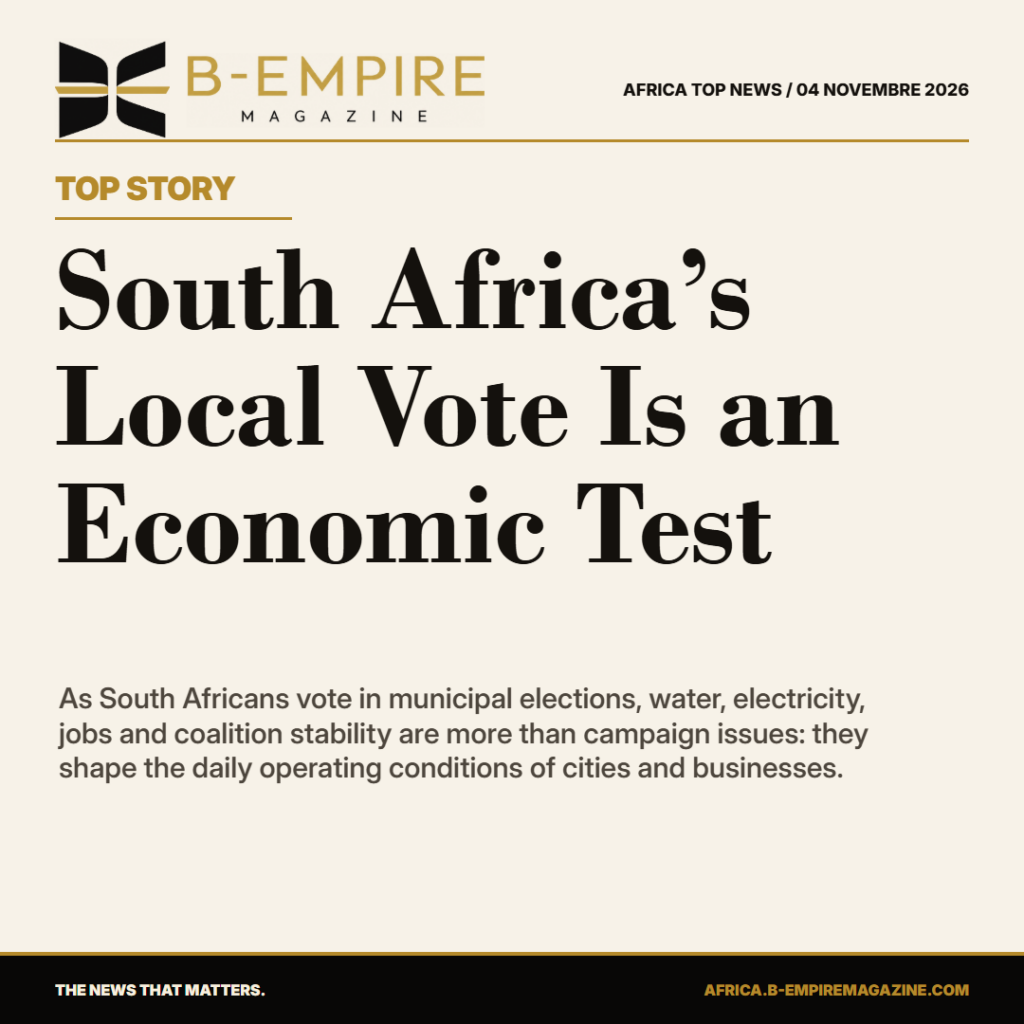
South Africans head to the polls on 4 November to elect municipal councils, with the quality of everyday services emerging as the central economic question in the country’s largest cities. Water, electricity, employment, public safety and housing are not abstract campaign themes: they determine whether households can plan their lives, whether firms can operate predictably and whether growing urban populations can access opportunity.
The Independent Electoral Commission set election day for 4 November, and the contest covers metropolitan, district and local councils across the country. The Electoral Commission certified 136,790 candidates for 10,526 seats, a scale that underlines how much is being decided below the national level. Voters will choose councillors; those councils will then shape local budgets, oversight and the political arrangements that determine how municipal administrations function.
National politics will inevitably colour the result. The African National Congress lost its parliamentary majority in 2024 and entered a national unity government with the Democratic Alliance and smaller parties. But municipal elections are also a more direct performance review: residents experience broken pipes, unreliable power, missed refuse collections, unsafe streets and the state of local roads close to home. A national party’s brand may help a candidate, but local delivery can just as easily become the deciding measure.
Why municipal performance reaches beyond city hall
Reliable water and electricity are basic public services, but they are also productive infrastructure. When supply is interrupted, businesses must absorb the cost of backup systems, lost operating hours or delayed deliveries. Households spend time securing water or navigating service failures instead of working, studying or caring for family. The costs are dispersed and often absent from a municipal balance sheet, yet they weaken productivity across an urban economy.
Reuters reported that about a third of Johannesburg’s water supply is lost, with ageing infrastructure, burst pipes, leaks and illegal connections among the causes identified by the city’s water agency. In eThekwini, more than half of the water supply is reportedly lost before reaching paying customers. These figures point to a problem that cannot be solved only by announcing new projects. It requires maintenance, reliable asset records, skilled procurement, enforcement against illegal connections and the financial discipline to keep networks functioning after construction.
Municipalities also face a difficult balance between affordability and investment. Tariffs and rates finance services, but sharp increases can strain households and small businesses. Holding charges down without a credible plan for collection, repairs and capital expenditure can leave infrastructure to deteriorate. Councils need transparent service targets and budgets that show how revenue translates into measurable improvements, rather than treating the tariff debate and the maintenance debate as separate political issues.
Jobs depend on local conditions, even when policy is national
Municipal government cannot by itself solve South Africa’s unemployment challenge. Monetary policy, national education and labour-market reforms, private investment and global conditions all matter. Yet cities influence the practical conditions in which employment can grow: land-use decisions, transport links, business permits, public markets, local infrastructure, safety and the predictability of utility services.
Reuters cited Statistics South Africa data showing that unemployment in Johannesburg rose to 35.9% in the second quarter, from 33.0% a year earlier, while Tshwane’s rate increased to 34.2% from 30.8%. The same reporting placed Cape Town and eThekwini lower among the major metros, at 21.9% and 21.2% respectively. These figures do not prove that one municipality’s policies caused the difference; cities have distinct industries, demographics and labour markets. They do show why a single national promise can feel remote from residents’ sharply different local realities.
For small businesses, municipal reliability can be a deciding factor in whether to formalise, expand or hire. A restaurant needs dependable water and waste services. A workshop needs power and safe access for staff and customers. A street trader depends on public space rules that are clear and applied consistently. Better municipal administration will not create jobs on its own, but weak administration can make existing enterprise more expensive and discourage new activity.
Coalitions need rules that last longer than the next vote
Several major cities have experienced coalition politics, and Johannesburg has had nine mayors in a decade, according to AP reporting. Coalition government can broaden representation, but frequent leadership changes can also disrupt priorities, weaken accountability and make it difficult to assign responsibility when services fail. Voters need to assess not only which parties may win seats, but whether those parties can agree on stable programmes and transparent decision-making.
Stability should not mean insulating a council from scrutiny or giving a coalition a blank cheque. Durable arrangements need published agreements, clear rules for leadership changes and routine reporting on budgets and service targets. When coalitions collapse, residents should be able to see what failed and who made the decisions. When they hold, residents should be able to compare commitments with results.
That accountability matters especially because councillors sit between the municipal administration and local communities. They can raise ward-level problems and scrutinise the executive, but they cannot personally repair every pipe or hire every municipal worker. Campaigns that promise immediate fixes without explaining authority, funding and implementation risk setting expectations that no council can meet. A more useful promise identifies the service, the responsible unit, the budget line, the timetable and the public measure of progress.
Safety and housing are part of the same urban equation
Crime and public safety remain major concerns across the metros. Reuters noted that some categories, including murders and carjackings, declined in certain cities in the first quarter, while violent crime remains high and gang violence continues to drive killings in parts of Cape Town. Local authorities do not control every policing function, but street lighting, safe transport access, land-use management, functioning public spaces and coordination with police can affect how safe residents feel and how they move through a city.
Housing and urban growth are closely connected. Rapid population movement puts pressure on affordable homes, sanitation, transport and water networks. When land-use planning and infrastructure investment fall behind, workers may live far from jobs, businesses face longer commutes for staff and city budgets inherit costly service backlogs. The challenge is not simply to build more units, but to connect housing to transport, employment and services in ways that are financially and environmentally sustainable.
Election campaigns can turn these complex systems into simple blame contests. Yet local problems often cross municipal boundaries or involve several spheres of government. Voters should expect candidates to distinguish what a municipality can deliver directly, what depends on provincial or national coordination, and what requires a long-term capital plan. Clarity about responsibility is not an excuse; it is a prerequisite for meaningful accountability.
What voters and businesses should watch after election day
The election is a decision about representation, but the first months of a new council will reveal whether the mandate becomes an operating plan. Watch for the formation of stable councils, publication of coalition agreements where relevant, adoption of realistic budgets and named responsibility for the most urgent service issues. Water-loss reduction, repair response times, electricity reliability, waste collection, road maintenance and payment discipline can all be tracked more usefully than broad slogans about renewal.
Businesses should look for predictable processes: prompt permitting, transparent procurement, accessible information about planned outages and infrastructure projects, and regular engagement with local agencies. Residents should be able to find out which official owns a problem and how to escalate it. Municipalities should publish performance information in formats that make comparison possible, including where targets are missed and what corrective action follows.
There is also a fiscal test. Councils need to collect revenue fairly, manage arrears and protect maintenance budgets while responding to immediate social needs. Underinvestment can look cheaper for a year and become far more expensive after a network fails. Conversely, capital spending without project oversight can produce debt and construction sites without better service. The public interest lies in expenditure that is both accountable and visible in residents’ daily lives.
South Africa’s municipal vote is taking place amid frustration with services and a shifting party landscape. The political consequences will matter, especially in cities where coalitions are likely. But the more durable measure of the election will be whether local government can restore the link between paying for services and receiving them. If councils deliver more reliable water, power, transport, safety and administration, the gain will reach beyond politics: it will strengthen the conditions for household security, business confidence and urban job creation. The ballot chooses the people responsible for that work. Only sustained, measurable delivery can complete it.