
Senegal’s Budget Rejection Leaves the Fiscal Adjustment Unresolved
Senegal’s National Assembly has rejected the government’s amended 2026 budget, sharpening questions over spending priorities, fiscal credibility and the path to a proposed IMF programme. The vote does not settle the country’s financing plan; it makes a more transparent and politically workable one urgent.
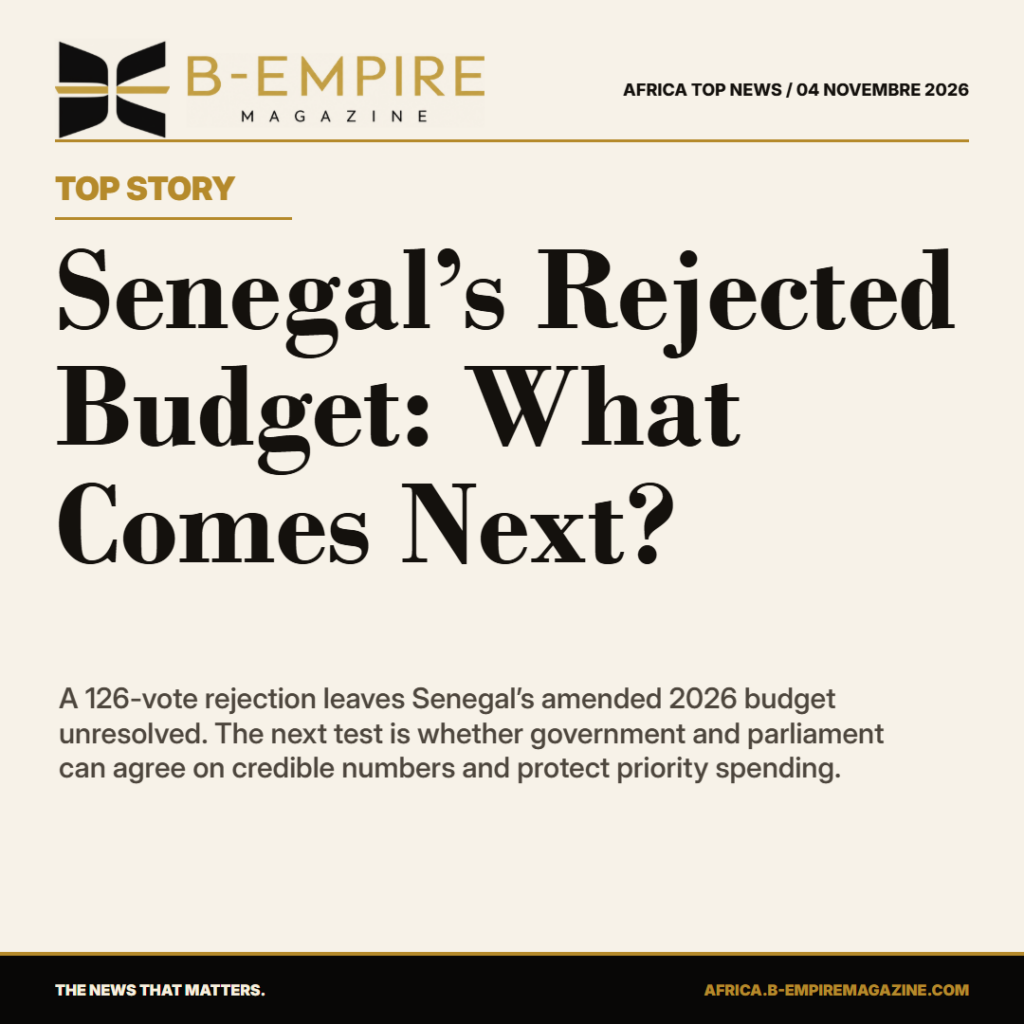
Senegal’s National Assembly rejected the government’s amended 2026 budget on 3 November, turning a dispute over fiscal assumptions and spending choices into a more immediate test of how the country will finance its priorities. The final tally was 126 votes against the bill, according to the Assembly’s corrected statement, out of 165 members. Reuters reported that the rejection could delay a proposed $2.2 billion International Monetary Fund programme, which still requires approval by the Fund’s Executive Board before money can be disbursed.
The vote does not itself produce a replacement budget, cancel the IMF process or determine which public services will be funded. It leaves the adjustment unresolved. Senegal’s government and legislators now face a practical question: can they agree on a credible account of available resources, debt-service needs and the measures required to protect essential spending, quickly enough to reduce uncertainty for the Treasury and investors?
A rejection with more than one message
The bill had already been turned down twice by the National Assembly’s Finance and Budgetary Control Committee. The plenary vote on Tuesday followed a procedural motion that ended further examination of the draft amended finance law. The Assembly’s public account cited lawmakers’ opposition to what they described as an insincere budget and cuts affecting social priorities, especially health and education. Reuters reported that 126 members ultimately voted against the bill after an initial technical problem in the count was corrected.
Those details matter because this was not a line-by-line amendment of the government’s proposal. The legislature rejected the text as a whole. That gives the executive a clear political signal but does not specify a parliamentary alternative for revenue, borrowing, subsidies or departmental allocations. A rejection can force renewed negotiation; it cannot on its own close a financing gap or protect a clinic, school or family-support payment.
The Finance Ministry’s 31 October statement had presented the amended law as necessary to align the original budget with changed resource and expenditure conditions. It said officials had provided committee members with additional documents and explanations on energy subsidies, family support and priority expenditure. That is the government’s account of the exchanges. Parliament’s rejection, and its stated concerns about social-sector reductions and budget credibility, show that the information and proposed trade-offs did not secure agreement.
The figures now need a public explanation
The dispute is not just about whether to spend more or less. The amended budget’s assumptions are central to how citizens, lenders and public agencies judge the government’s plan. Reuters reported that the revision lowered projected 2026 real growth to 2.7%, from roughly 5% in the original budget, and put the deficit at 7.6% of gross domestic product, up from 5.4%. PASTEF lawmaker Amadou Ba argued that the deficit should instead be revised down to 6%. Finance Minister Cheikh Diba said the 7.6% figure was a ceiling that should not be exceeded, rather than a firm forecast.
Different interpretations of a deficit number can translate into very different policy choices. If the projection is a ceiling, lawmakers and the public need to see the baseline forecast, the downside scenarios and the measures that would keep borrowing within the limit. If a lower deficit is the aim, the plan should identify which revenues will materialise, what expenditures can realistically be reduced, and how those changes affect growth and public services. Publishing a number without making its assumptions legible risks turning a technical budget debate into a contest of assertions.
Transparency is especially important when the country is trying to restore confidence after previously unreported borrowing came to light. Reuters cited IMF figures putting Senegal’s debt burden at 132% of GDP at the end of 2024. That history raises the stakes for reliable reporting of liabilities, guarantees, arrears and the timing of payments. It does not predetermine the right fiscal policy, but it makes verifiable data and consistent definitions indispensable.
IMF financing is an important, conditional part of the picture
Senegal reached a staff-level agreement with the IMF in early September on a proposed $2.2 billion programme, Reuters reported. A staff-level agreement is not the same as an approved programme or a disbursement. The Fund’s Executive Board must still consider it. A budget impasse may complicate that process, but it would be inaccurate to describe the parliamentary vote as automatically ending the agreement. The immediate effect is to prolong uncertainty around a fiscal plan that forms part of the broader financing and debt strategy.
Nor is an IMF programme a substitute for domestic political consent. External financing can help meet near-term needs and support a wider adjustment, but a durable plan must be understood and implemented by the institutions responsible for spending and oversight. Legislators who reject a proposal should be pressed to explain the alternatives they support; the executive should make the underlying figures and distributional effects clear enough for those alternatives to be debated. Accountability runs in both directions.
The government has said that prolonged uncertainty could jeopardise funding for 2026 resource gaps and increase pressure on state cash flow, potentially affecting priority spending. That warning is the ministry’s stated assessment, not proof that each feared consequence will follow. Still, cash management becomes harder when a budget’s legal authority and financing assumptions are in dispute. Public agencies need predictable releases, contractors need clarity on payment schedules, and households need to know whether support programmes are funded.
What a workable next step should include
The next round should begin with a shared, public fiscal baseline: revised revenue estimates, debt-service obligations, financing sources and a transparent reconciliation between the original budget and the proposed amendment. That baseline should distinguish a central forecast from a maximum deficit ceiling and show how each is calculated. Any changes in assumptions should be dated and explained so that subsequent revisions can be tracked rather than silently absorbed.
Second, the proposed spending adjustments need to show who bears the cost. If energy subsidies are being changed, the plan should state how the savings are estimated and what protections exist for lower-income households. If family support payments or health and education budgets are affected, the amounts, timing and beneficiaries should be clear. A national total can conceal very different outcomes for regions and income groups; lawmakers need enough detail to test those effects.
Third, Parliament should have a defined route from rejection to decision. That could mean a revised bill, a documented set of amendments, or a published timetable for renewed review. The exact constitutional and budgetary steps are for Senegal’s institutions to determine. But a timetable and clear public documents would help markets and citizens distinguish a functioning negotiation from indefinite deadlock.
Finally, the government and parliament should publish a regular implementation update. Budget credibility is not established only when a law passes. It is tested when revenues come in below forecast, when spending must be reprioritised, and when debt payments fall due. Quarterly reporting on commitments, disbursements, arrears and financing would allow the public to assess whether the agreed plan is being followed.
The real test is whether trust can be rebuilt
Senegal’s vote is a serious setback for the government’s current budget proposal, but it is also an opportunity to make the next one more defensible. A revised law that simply returns with the same unexplained assumptions could reproduce the same division. A plan that acknowledges fiscal constraints, sets out transparent choices and protects clearly defined priorities would give lawmakers something concrete to scrutinise.
For investors, the central issue is not whether the deficit target looks reassuring in isolation. It is whether the numbers can be reconciled with actual debt obligations, whether the institutions will report deviations, and whether political agreement is strong enough to implement the plan. For citizens, the measure is more immediate: whether essential services and support arrive as promised, and whether the burden of adjustment is openly debated.
The 126-vote rejection leaves those questions unanswered. The next budget process should not be treated as a formality to unlock external money, nor as a political contest in which rejecting the government’s figures is sufficient. Senegal needs a fiscal framework that can withstand scrutiny, command legislative support and translate into predictable public services. Until that framework is agreed, uncertainty itself will remain part of the country’s economic problem.