
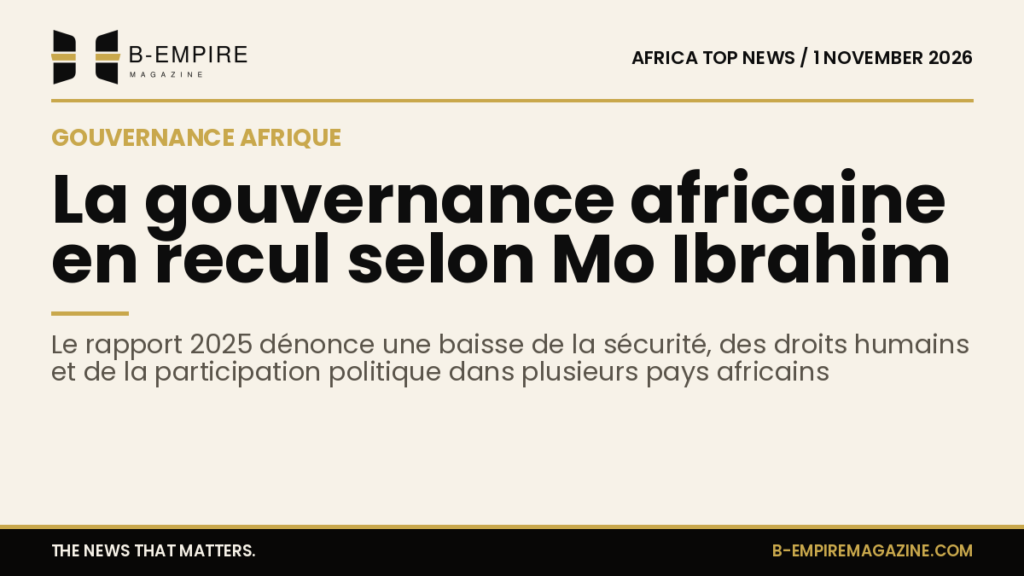
Africa’s governance suffers as strongmen rise globally, says Mo Ibrahim
Mo Ibrahim, head of the Mo Ibrahim Foundation, highlights a decline in democracy and rights across Africa linked to the global rise of authoritarian leaders. Despite economic progress in some countries, security, human rights, and public participation have worsened amid coups and political repression. He calls for African self-reliance following cuts in US aid and stresses the potential of Africa's youth.
Brève Publié le (Africa/Lagos, UTC+1) · mis à jour le (v2)
Mo Ibrahim, chairman of the Mo Ibrahim Foundation, has warned that Africa is experiencing a decline in governance quality amid a global rise of strongmen leaders. According to the Foundation’s 2025 governance report, while economic opportunity and human development have improved in some African countries over the past decade, there have been steep declines in security, human rights, and public participation.
The report notes that 30 countries, representing half of Africa’s population, improved their governance scores since 2016, largely due to better economies. However, 23 countries saw deterioration, with Burkina Faso, Nigeria, Sudan, and Tunisia among those with the largest declines, often linked to coups and reduced political rights.
Ibrahim attributes this trend partly to the weakening of liberal democracy worldwide, citing examples from the United States, Europe, and Russia. He criticizes the rise of transactional diplomacy, particularly under the Trump administration, for undermining international order and the rule of law.
He also highlighted recent elections marked by violence, such as in Tanzania and Uganda, where opposition figures faced repression. The sudden termination of USAID funding last year, which ended billions in support to African nations, was described by Ibrahim as “brutal,” urging more notice and greater African self-reliance.
Despite these challenges, Ibrahim remains hopeful about Africa’s future, emphasizing the continent’s youthful population, with 60% under 25 and projected to represent one-third of the global youth by 2050.
Mise à jour, 2 Nov 2026, 15h50 (Africa/Lagos, UTC+1) : Updated with the latest source confirming and slightly expanding details on governance decline, election violence, and USAID funding cuts as reported by Mo Ibrahim and the Mo Ibrahim Foundation.