
WHO Survey of 44 African Countries Exposes Patient Safety Data Gap
A WHO survey of 44 African Region countries finds uneven patient safety progress and its largest gap in reporting and learning systems, a concern for people needing years of chronic disease care.
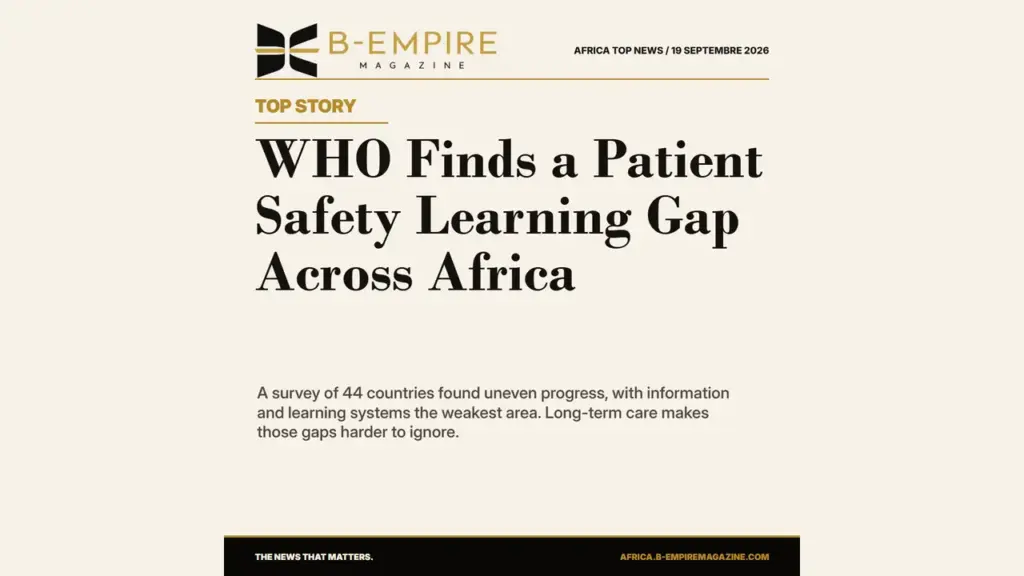
A World Health Organization survey covering 44 of the 47 countries in its African Region has found uneven progress on patient safety, with the largest weakness in systems that record mistakes and turn them into lessons. WHO released the 2025/26 regional findings on 17 September, World Patient Safety Day, as it highlighted the risks faced by people who need continuous care for diabetes, cancer, heart disease and other noncommunicable conditions.
The survey is an assessment of how health systems are implementing the Global Patient Safety Action Plan 2021-2030. WHO says clinical processes were the strongest area reviewed. Information and learning systems lagged furthest behind, while workforce capacity, engagement with patients and families, and partnerships also need work. The announcement does not provide a country-by-country league table or a measured regional rate of medical errors; it should not be read as one.
That distinction matters. A weak reporting system does not prove that one country causes more harm than another. It does make it harder to detect patterns, fix unsafe processes and show patients that a complaint led to change. A health service that cannot learn reliably from near misses or adverse events is flying with an incomplete picture of its own risks.
Why chronic care raises the stakes
Noncommunicable diseases, often called NCDs, are not usually managed in a single appointment. A person with hypertension may need repeated checks and medication changes. Someone with cancer may move among screening, diagnosis, surgery, treatment and follow-up. Diabetes care can involve laboratories, pharmacies, primary care and specialist referrals over many years.
Each transition creates an opportunity for information to be lost. WHO identifies delayed or missed diagnosis, medicine errors, harmful drug interactions, weak follow-up and poor communication between services as risks along that journey. One incomplete referral or an outdated medication list can undermine otherwise competent work by several clinicians.
The burden is growing. WHO says NCDs accounted for 37% of all deaths in its African Region in 2019, compared with 24% in 2000, and that nearly two-thirds of NCD deaths in the Region are premature. Those figures describe the broader disease burden, not the number of deaths caused by unsafe care. The survey’s message is that expanding access to chronic care must be matched by the ability to provide it safely over time.
The WHO African Region is a defined group of 47 countries. The survey included 44 of them, not every country on the African continent. Its broad participation makes the finding important, but the public release gives limited detail on the methods and variation among countries. Policymakers should use the survey as a warning about system priorities, not as a shortcut to claims about any individual hospital.
From reporting to learning
An incident-reporting form is only the beginning of a safety system. Staff and patients must be able to report concerns; facilities must investigate them; and managers must change the processes that caused them. Lessons then need to travel beyond one ward or clinic when the same risk exists elsewhere.
WHO calls for systems that let health workers report and learn without fear of blame. That does not remove professional accountability for serious misconduct. It recognises that punishing every person who reports an error can drive useful information underground. A learning culture asks what conditions made a mistake possible, whether similar mistakes are likely and which safeguards would make care more reliable.
Information systems should connect different stages of a patient’s care. Accurate records, clear handover notes, medicine reconciliation and a documented referral outcome are practical safety tools. Digital platforms can help, but buying software is not the same as making data complete, usable and protected. Paper systems with clear responsibilities may outperform a digital system that nobody updates.
Facilities also need to show what happened after a report. Publishing aggregate data on incidents, investigations and corrective actions would help build trust without exposing private patient information. Simple measures, such as whether follow-up appointments occur and whether referrals reach the next provider, can make the promise of continuity visible.
Kenya shows the implementation challenge
Kenya’s activities around World Patient Safety Day illustrate how the regional concern meets local practice. WHO reports that a Nairobi conference from 9 to 11 September brought together health workers, policymakers, researchers and patient representatives to discuss safer NCD care. Its agenda included diagnostic quality, medicine safety, care coordination, digital tools and the experience of patients moving through several services.
WHO also describes work under its PEN-Plus and Women Integrated Care Services initiatives in Busia, Kericho, Bungoma and Nyandarua counties. Equipment for cervical cancer screening and treatment was delivered to selected facilities in Bungoma and Nyandarua in June, accompanied by training. Those are implementation steps, not proof that every patient in those counties now receives safe or timely care.
The Kenya account notes practical tools such as patient handover notes, multidisciplinary case reviews and medicine reconciliation for people with several conditions. Their appeal is that they address the points where harm can arise: a changed prescription not communicated to the next clinic, an abnormal result not followed up, or a referral that never closes the loop.
Kenya should not be treated as a stand-in for all 44 survey participants. Its experience offers a concrete example of the policy-to-practice work that the regional finding demands. Other countries will need approaches suited to their own staffing, supply chains, records systems and geography.
Patients and families belong in the system
WHO says people living with NCDs and their families can identify breakdowns that institutions overlook. They know when records disappear between facilities, instructions conflict or a treatment plan is impossible to follow because medicines are unavailable. Their participation should extend beyond a one-off consultation to the design and review of services.
Health systems can make that participation safer by providing clear information in languages patients understand, explaining who to contact after a missed test result and offering a route to raise concerns without jeopardising care. Patient representatives can also help review recurring problems, while confidentiality protections keep individual cases from becoming public spectacles.
The workforce needs support as well. Training and supervision matter, but so do reliable medicines, functioning diagnostic equipment, manageable workloads and referral options. A nurse cannot deliver continuity by goodwill alone if essential records or supplies are missing.
The next test for health authorities
WHO is asking countries to embed safety in NCD policies, invest in staff competencies, strengthen incident reporting and promote safe use of medicines and health technologies. The next useful step would be to publish clear national baselines: what is reported, how quickly incidents are reviewed, whether corrective action is completed and how patients experience the transition between services.
The 2025/26 survey provides a regional diagnosis of uneven systems, not a ready-made cure. Its strongest finding is that many services need a better way to learn. For people who must return for care month after month, that learning is not administrative detail. It is how a health system reduces the chance that the next appointment repeats a preventable harm.