
African Union Names Fathallah Sijilmassi G20 Envoy for Debt and Climate Talks
The African Union has appointed Fathallah Sijilmassi as special envoy for G20 and global affairs. His task is to help turn shared African priorities into coordinated positions, under the AU G20 Sherpa.
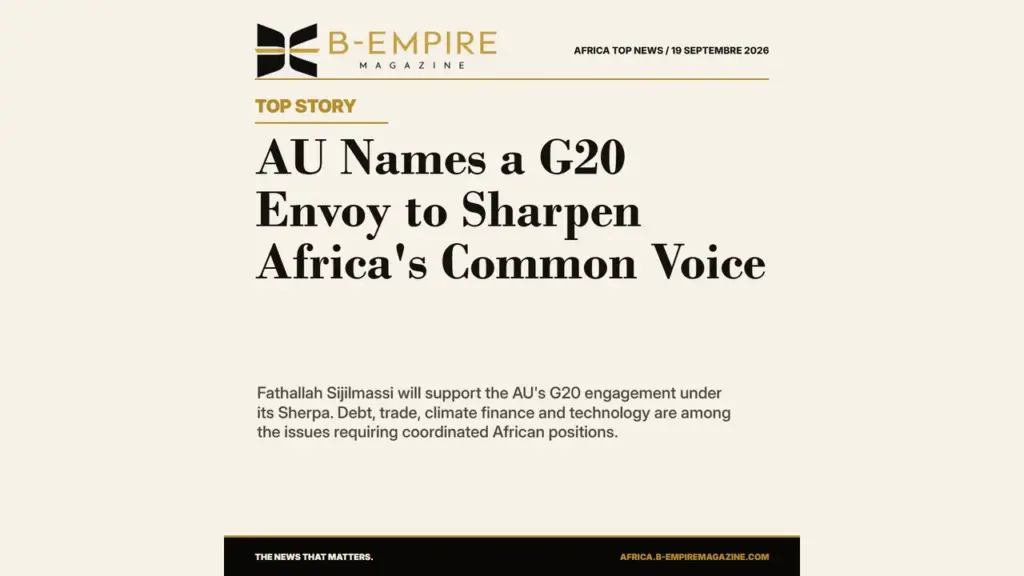
The African Union has appointed Ambassador Fathallah Sijilmassi as Special Envoy for G20 and Global Affairs, adding diplomatic capacity to its effort to speak with greater coherence on decisions that shape Africa’s economic future. The African Union Commission announced the appointment on 18 September. It says the envoy will support Commission Chairperson Mahmoud Ali Youssouf and consult member states, partners and other stakeholders on issues of strategic importance to the continent.
The precise reporting line matters. On G20 matters, Sijilmassi is to work under the authority of the AU G20 Sherpa and within the Union’s existing G20 governance. The announcement does not create a second, competing African seat at the table. It creates a role intended to strengthen preparation, consultation and follow-through around the seat the AU already holds.
The AU became a permanent member of the G20 in 2023. Membership secured a formal place in a forum that discusses debt, growth, trade, financial regulation and climate policy. It did not automatically produce a unified position across the continent’s different economies. The new envoy’s value will depend on whether he can help turn a broad ambition for representation into specific, agreed proposals that member states can defend.
A coordination role, not a new mandate to set policy alone
The AU says Sijilmassi will support engagement with the G20 and other multilateral platforms. He is expected to consult governments, international partners and relevant stakeholders, then help promote coordinated African positions. The appointment notice names global governance, international financial architecture, sustainable development, trade, climate action and technology among the subjects in scope.
These are not separate conversations in practice. A country’s ability to invest in energy, digital infrastructure or climate resilience is shaped by the cost of borrowing, access to markets and the rules of international finance. Yet African governments do not all face the same debt profile, export mix or energy needs. A common position has to identify shared interests without erasing those differences.
That is why the envoy’s consultations may be as important as his appearances at international meetings. The most persuasive continental proposal is one that finance ministries, central banks, regional economic communities and AU institutions have tested against their own realities. A polished statement drafted without that groundwork would be less useful when detailed negotiations begin.
The role should also clarify how different parts of the AU speak to one another. The Sherpa process, the finance track and the Commission’s thematic departments each handle pieces of a wider agenda. Stronger coordination could reduce duplicated work and prevent Africa’s priorities from being diluted into many unconnected messages.
Debt is a concrete test of a common position
The AU’s work on debt provides an immediate example. African leaders adopted a Common African Position on Debt in February 2026, according to the Commission’s July debt-dialogue brief. That brief says more than 20 African countries are in debt distress or at high risk, while debt-service obligations reduce room for spending on health, education, infrastructure and climate resilience.
At its July dialogue in Harare, the AU set out work on implementation arrangements, a potential unified African term sheet, guidelines for debt reprofiling and advocacy for reform of the G20 Common Framework for Debt Treatment. These are technical ideas, not just calls for solidarity. They need negotiation with governments and creditors as well as agreement among African institutions.
An envoy cannot rewrite debt contracts or compel creditors to accept a new framework. He can help ensure that the AU’s adopted position is carried consistently through preparatory meetings and that member-state concerns are reflected before a negotiation reaches the leaders’ level. The test will be whether African proposals become more specific and gain traction, rather than merely appearing more often in communiques.
Previous AU G20 engagement has already pressed for changes to the debt-treatment framework and a broader reform of global finance. The July 2025 AU account of a Sherpa meeting also described priorities around industrialisation, employment, sustainable finance and climate action. Sijilmassi inherits an agenda with existing institutional work behind it; his appointment should be judged by what it advances, not by treating those priorities as newly invented.
Trade, climate and technology need the same discipline
Trade illustrates the challenge of speaking for a diverse continent. A stronger African voice can argue for fairer market access and more value added on the continent, but the negotiating needs of a commodity exporter, a manufacturing hub and a small island economy are not identical. The envoy’s consultations should identify the points of agreement and make clear where further decisions belong to member states.
Climate finance poses a similar problem. African countries need capital for adaptation, energy access and resilience, but the form of that capital matters. New loans can help finance investment while also adding to already strained debt burdens. Coordinated advocacy should therefore examine cost, maturity, grants, risk sharing and access conditions, not only the headline volume of promised funds.
Technology policy is another area where Africa’s interests can be articulated more sharply. Rules on data, artificial intelligence and digital trade influence whether local firms can build capacity or remain dependent on imported systems. The AU announcement includes technology among the envoy’s areas of engagement, but it does not specify a new technology deal or policy. Any concrete position will require separate consultation and approval.
The breadth of the portfolio makes prioritisation unavoidable. An envoy who attempts to lead every issue at once risks becoming another layer of meetings. A practical agenda would identify a small number of decision points, the institution responsible for each, and the member-state positions needed before negotiations advance.
What success would look like
The appointment should be followed by a transparent work programme. The AU could publish the consultation sequence, describe how member states and regional bodies feed into G20 positions, and distinguish agreed continental priorities from proposals still under discussion. That would help businesses, researchers and civil society understand where they can contribute evidence.
Progress can then be judged against tangible questions: Did African governments align on a debt-reform proposal? Were climate-finance demands expressed in negotiable terms? Did G20 discussions reflect those positions? Were outcomes reported back to member states, including what was rejected or deferred? Diplomatic access is valuable, but accountability requires more than a photograph from a summit.
The AU’s permanent G20 membership gives Africa a standing place in global economic discussions. Sijilmassi’s appointment is an attempt to make that place more effective while preserving the existing Sherpa structure. Its significance will be measured by disciplined consultation and credible collective positions, followed by evidence that those positions changed the conversation and, eventually, the decisions affecting people across the continent.