
Morocco’s 2026 Election Is a Test of Whether Politics Can Rebuild Youth Trust
With more than 15.8 million registered voters and a campaign shaped by youth unemployment, public services and political trust, Morocco's September 23 election will test more than party strength.
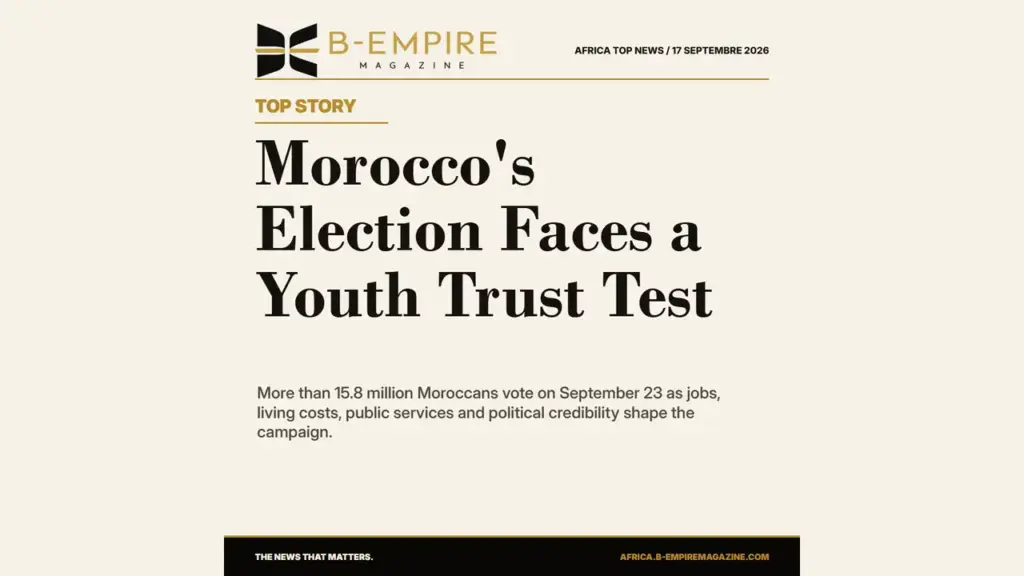
Morocco will elect a new House of Representatives on September 23 in a vote that is becoming a test of whether formal politics can reconnect with a young population frustrated by unemployment, living costs and uneven public services. More than 15.8 million voters are registered. Official election data records 1,850 candidate lists, 7,288 candidacies and 28 political formations competing during a campaign that runs from September 10 until midnight on September 22.
The numerical scale suggests intense competition, but the more important question is participation. Morocco has built a detailed election framework covering campaign finance, media access, digital content and observation. Those procedures can protect the integrity of voting. They cannot by themselves persuade citizens that elections will improve daily life.
For younger Moroccans, the campaign is taking place against a difficult labour market. An IMF report published in March highlighted youth unemployment of 36.8 percent among people aged 15 to 24 in the 2024 labour-force survey, up sharply from 2019. It also found that many educated unemployed people had never held a job. The figures help explain why employment, household pressure and the quality of public services are central political issues.
A crowded contest with a credibility problem
The election will determine the composition of the 395-seat lower house and shape the formation of the next government. Competition is broad: thousands of candidates are seeking seats through local and regional lists, and parties are campaigning across urban and rural constituencies.
Yet political competition is meaningful only when voters believe it offers distinct choices and consequences. A crowded ballot can demonstrate pluralism, but it can also fragment attention if programmes are vague or coalitions make accountability difficult. Parties must show not only what they oppose, but what they would implement, how it would be financed and how voters could measure performance.
This credibility challenge is especially sharp among young people. Morocco has invested heavily in infrastructure, manufacturing, renewable energy and preparation for major international events. Those projects signal ambition and can create growth. The political question is whether that growth produces accessible jobs, affordable housing and better local services for people entering adulthood.
Jobs are the campaign’s economic core
Youth unemployment is not simply a result of weak education. Morocco faces a mismatch between qualifications and available work, regional disparities, low participation by women and an economy that does not create enough productive jobs for the number of new entrants. The IMF has urged reforms to labour-market policy, private investment and structural unemployment.
Campaign promises should therefore be assessed on their employment mechanisms. A pledge to create jobs is not a programme. Voters need to know which sectors can absorb workers, what regulations will change, how small firms will gain finance and whether training programmes are tied to actual employer demand.
Manufacturing and export industries offer one route, but they require logistics, reliable energy and stronger supplier networks. Tourism creates employment but can be seasonal and concentrated geographically. Digital services can reach global markets but cannot absorb everyone. Agriculture remains crucial in rural areas, where drought, water scarcity and low productivity shape livelihoods.
A credible jobs agenda will therefore be mixed: improve conditions for small and medium-sized enterprises, connect training to industrial clusters, support women entering paid work, reduce barriers to formal hiring and strengthen rural value chains. The election is an opportunity for parties to explain those tradeoffs rather than compete only through headline targets.
Public services and the geography of trust
Political trust is experienced locally. A citizen may judge government through the nearest school, clinic, bus route, administrative office or water supply. National investment can coexist with frustration when service quality differs sharply between major cities, smaller towns and rural communities.
Official campaign coverage has highlighted rural development and young voters in regions including Essaouira and Souss-Massa. That focus reflects a real political divide. Rural voters face employment and service challenges that differ from those of Casablanca, Rabat or Tangier. Parties need region-specific programmes rather than a single national message.
Decentralisation makes local capacity important even in a legislative election. Parliament sets laws and scrutinises government, but delivery often depends on regional and municipal institutions. Candidates who promise improved services should explain how funding, authority and accountability will move through those layers.
Women are more visible, but representation is not yet equal
Women account for about 46 percent of registered voters and approximately 36.5 percent of candidates, according to election information published after nominations closed. That is significant participation, but candidacy does not automatically translate into influence.
The placement of women on winnable lists, the positions they hold within parties and the portfolios they receive after the election will matter more than the headline share alone. Campaign debate should also address the economic barriers that reduce women’s labour-force participation, including care responsibilities, transport, workplace conditions and unequal access to finance.
Political representation can improve policy when women have genuine authority rather than symbolic inclusion. Voters and observers should therefore track both the number of women elected and their role in parliamentary leadership, committees and government formation.
More than 3,000 observers will watch the process
Morocco has mobilised more than 3,000 election observers, including national institutions, domestic associations and international bodies. Observation can strengthen confidence by documenting whether voting procedures are followed, candidates can campaign freely and complaints are handled consistently.
The legal framework includes rules against vote buying, intimidation and misuse of public resources. Campaign accounts must be submitted after results are proclaimed, and spending is subject to review. Those safeguards are important because procedural fairness affects whether losing parties and their supporters accept the outcome.
Observation should extend beyond polling day. Candidate registration, media access, public administration, campaign finance, counting and dispute resolution all shape integrity. Timely publication of detailed results can also reduce misinformation and allow independent analysis.
The digital campaign creates a new integrity test
Social media has become a central arena for Morocco’s political competition. It allows parties and candidates to reach young voters directly, but it also accelerates false claims, manipulated media and personal attacks. The 2026 framework addresses falsified content and digital practices that could harm candidates or the credibility of the election.
The High Authority for Audiovisual Communication has adopted rules intended to protect political pluralism and the neutrality of broadcast media during a 39-day electoral period. These measures seek fair access while prohibiting hate speech, racism and violence.
Enforcement must balance election integrity with freedom of expression. Overbroad restrictions can suppress legitimate criticism, while weak enforcement can allow coordinated deception to overwhelm public debate. Authorities should apply rules transparently, publish decisions and distinguish harmful fabrication from satire, opinion and ordinary political argument.
Parties also carry responsibility. They should identify official accounts, correct false information circulated by supporters and disclose paid digital advertising. Platforms should respond rapidly to impersonation and manipulated content while preserving evidence for regulators and observers.
What the election can and cannot change
Morocco’s constitutional system distributes authority among elected institutions, the government and the monarchy. Voters are choosing parliament, not rewriting that wider structure. The election nonetheless matters because legislation, budgets, ministerial priorities and parliamentary scrutiny affect employment, services and economic reform.
Parties should be judged within the powers they can actually exercise. Unrealistic promises deepen cynicism. Clear commitments on laws, spending and oversight can instead make accountability possible. After the vote, coalition negotiations should preserve enough programme clarity for citizens to understand which party is responsible for which decision.
A participation test before a results test
The immediate media focus after September 23 will be on seats, winners and coalition arithmetic. But turnout and demographic participation may reveal more about the health of Moroccan politics. High registration does not guarantee high voting, especially when younger citizens doubt that institutions respond to them.
Parties have less than a week to make the case that voting can affect jobs, prices and public services. That argument cannot rest on slogans. It requires credible programmes, candidates who engage locally and a process voters consider fair.
Morocco’s 2026 election is therefore a double contest. Political parties are competing for parliament, while the political system is competing for public confidence. The first contest will produce a result within days. The second will be judged over the years that follow, by whether citizens see opportunity, accountability and services improve after the ballots are counted.