Ghana’s Climate-Finance Accreditation Opens a Door, Not a Cheque
The Ghana Infrastructure Investment Fund’s new Green Climate Fund accreditation gives it a direct national route to propose climate projects. It does not guarantee funding: Ghana still needs a strong pipeline of bankable, locally endorsed projects that pass the Fund’s review.
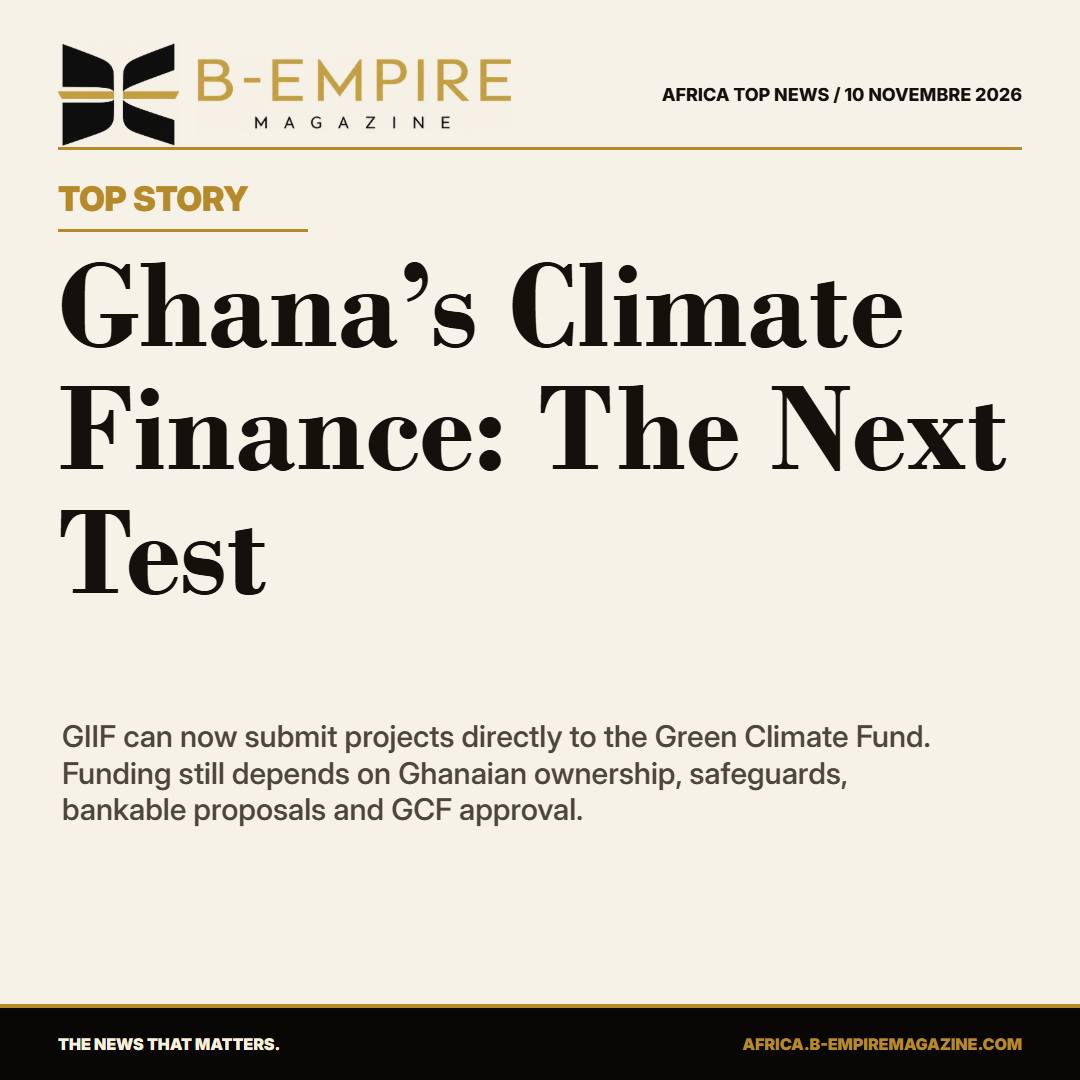
Ghana has gained a new institutional route into international climate finance. The Ghana Infrastructure Investment Fund (GIIF) has been accredited by the Green Climate Fund (GCF) as a national direct-access entity, following approval at the GCF’s 46th Board meeting. The milestone gives a Ghanaian institution the ability to develop and submit funding proposals to the Fund without routing them through an international accredited entity.
That is meaningful, but the distinction between access and funding matters. Accreditation is not a cash allocation, a project approval or a guarantee that any proposal will be financed. It is permission to enter the GCF’s formal project pipeline under defined standards and responsibilities. Ghana’s practical test now shifts to identifying strong projects, securing national endorsement, preparing the evidence and co-financing arrangements, and meeting the Fund’s environmental, social and financial requirements.
What direct access changes
GIIF is Ghana’s public infrastructure investment vehicle. Its mandate is to identify, develop, invest in and mobilise resources for infrastructure that supports national development. The Fund says it can work with public and private partners and use instruments including loans, equity and guarantees across its portfolio. Its climate priorities include renewable energy, sustainable transport, nature-based solutions, energy efficiency, sustainable agriculture, biodiversity and resilient social infrastructure.
As a national direct-access entity, GIIF can take a more active role in shaping proposals around Ghana’s investment priorities and in coordinating local public and private partners. That can help the country develop projects with domestic knowledge of the infrastructure landscape, instead of relying entirely on an outside institution to originate and structure each proposal. It may also allow the Fund to connect climate objectives with the financial and delivery questions that determine whether infrastructure is built and maintained.
The word “may” is important. GIIF’s accreditation profile lists its status as national direct access and identifies its risk category as Category B, Intermediation 2. The accreditation scope and applicable policies govern what it can submit and how it must assess projects. The new channel is not an unrestricted mandate to fund every climate-related proposal, and each project must fit the relevant rules.
The approval chain is still real
The GCF’s process requires more than an accredited institution. Funding proposals are assessed against investment criteria, standards and country priorities. The Fund’s published project cycle says proposals must include a no-objection letter from the country’s National Designated Authority or focal point, showing that the proposal is consistent with country-driven approaches and national climate strategies. Proposals also undergo completeness checks and technical review; larger or more complex projects may follow the regular funding route, while eligible smaller and lower-risk projects may use a simplified approval process.
The GCF Board ultimately decides whether a funding proposal is approved. If approval is granted, the institution and the GCF still need to complete legal arrangements before funds are disbursed, followed by monitoring during implementation. Accreditation therefore creates a platform for GIIF to bring forward projects, but it does not bypass appraisal, country ownership, safeguards or Board oversight.
For local communities and project developers, those safeguards are not bureaucratic decoration. Infrastructure can affect land access, livelihoods, ecosystems and public budgets. A viable proposal must show how it manages those risks, who benefits, how outcomes will be measured and how the asset will keep operating after construction. A power project that does not connect reliably to users, or a flood-protection scheme without maintenance funding, may fail even if the engineering is sound.
From broad priorities to a bankable pipeline
GIIF’s sector list is broad. Converting it into a usable pipeline requires choices. Ghana could prioritise projects where climate resilience and economic value reinforce one another: reliable clean power for productive industry, transport systems less exposed to flooding, water infrastructure able to withstand changing rainfall, or nature-based measures that protect settlements and economic assets. The list is illustrative, not an announcement that any of these projects has been submitted or approved.
Each candidate needs a clear sponsor, a feasibility case, credible cost estimates, environmental and social assessment, an implementation plan and a financing structure. Projects also need to demonstrate additional climate value, rather than simply relabeling ordinary infrastructure spending as climate action. If the proposal combines GCF support with domestic funding, private investment or concessional finance, the roles and risks of each source need to be transparent.
This preparation work is where national ownership becomes concrete. Ministries and local authorities must align projects with Ghana’s climate plans and development priorities. GIIF needs a transparent way to select and prepare proposals. Private partners should be able to understand procurement, revenue assumptions and risk allocation. Communities affected by projects need meaningful engagement before plans are locked in. Without this work, direct access can remain an institutional achievement with little effect on construction sites or household resilience.
Why project quality matters more than the announcement
The accreditation arrives as Ghana and other African economies seek larger volumes of climate investment. A national institution can help build familiarity with local projects, coordinate sponsors and retain more of the structuring capacity at home. It may also make it easier to develop a sequence of proposals rather than depend on occasional, externally led transactions. But these benefits depend on GIIF’s ability to maintain the governance, technical capacity and environmental and social standards that accreditation requires.
There is also a financing discipline to preserve. Climate funds are not interchangeable with domestic infrastructure capital, and concessional finance still carries obligations. A project must be affordable to operate, resilient to climate and market risks, and clear about who repays any loans or bears losses. GIIF’s commercial investment mandate makes careful project economics especially relevant: climate impact and financial sustainability must be reconciled, not treated as competing slogans.
Ghana’s direct-access status is best understood as a door opened, not a cheque delivered. It gives GIIF a formal place from which to bring Ghanaian infrastructure proposals to the Green Climate Fund. The next measure of success will be whether the institution can assemble a credible, locally endorsed pipeline, secure approvals and turn them into infrastructure that lowers emissions or protects people from climate risks. That is a longer test than accreditation, and the one that will determine whether the new access changes outcomes on the ground.