
South Africa’s 1.4 Million Special Votes Put Election Access in Focus
More than 1.42 million South Africans cast special votes ahead of the 4 November local elections, including through home visits. The figure is a major operational milestone, but not a measure of overall turnout. It highlights how accessibility, ballot logistics and public trust shape the country’s municipal vote.
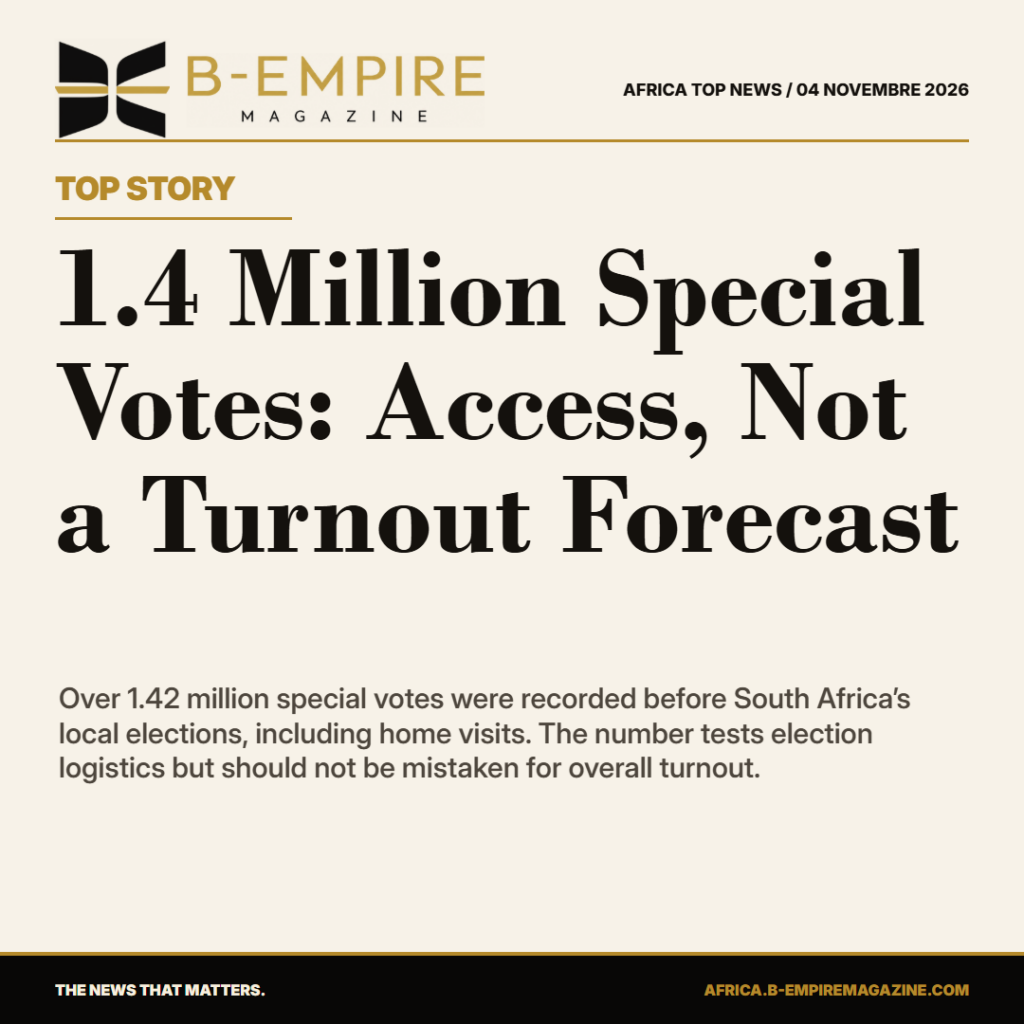
South Africa recorded 1,425,942 special votes during the two days before its 4 November local elections, according to the Electoral Commission’s final tally reported by government news service SAnews. The votes were cast at polling stations and through home visits for registered voters who could not reasonably vote on election day. The scale is significant for election administration, but it is not a turnout estimate for the wider electorate: special voting is a defined access mechanism, not a survey or an early result.
The Commission had approved approximately 2.66 million applications for special voting, covering people with physical infirmities or disabilities and voters who could not be at their registered polling station on election day. Of those approved, 1,425,942 votes were recorded on 2 and 3 November. SAnews reported that 974,852 were cast at voting stations and 451,090 through home visits. The approvals and votes cast are different measures; the number who used the option should not be presented as the share of all South Africans who voted.
With the main polls now open, the special-vote operation offers an early look at one of democracy’s less visible tests: whether a large, geographically dispersed electorate can access the ballot in more than one way without compromising the safeguards that make each vote valid.
Special voting is access infrastructure
South Africa’s local election determines councils across metropolitan, district and local municipalities. The Electoral Commission’s rules allow approved voters to cast a special vote at the station where they are registered or, for those unable to travel because of physical infirmity or disability, through an authorised home visit. In both cases, the voter must be on the approved list and follow the established identification and ballot procedures.
These arrangements can make participation possible for older people, people with disabilities and others whose circumstances prevent them from attending on the main day. Their value is not merely symbolic. If a voting system is accessible only to people who can travel, wait in a queue and manage a standard polling environment, it excludes eligible citizens for reasons unrelated to their political choice.
Home visits also create additional logistics. Election teams must travel to addresses, verify identities and approvals, secure ballot materials and ensure votes are handled according to procedure. That requires advance planning, enough trained staff and clear records. Station-based special votes add another layer to the regular operations happening at those sites. A high number of applications therefore tests the Commission’s capacity before election day itself.
Why the vote total should not be read as a turnout signal
The 1.42 million total measures use of the special-voting channel among approved applicants. It does not tell us how many people will vote in the full election, how competitive a party’s support is or what the result will be in any ward. Special voters are selected because of their circumstances, and their ballots are counted as part of the election under the normal rules. Their participation is not a representative sample of all registered voters.
The distinction matters in a politically charged contest, when partial numbers can be misused to suggest momentum or predict a result. The Electoral Commission has separately cautioned against misinformation about election procedures and fabricated or manipulated claims. Citizens and political parties should wait for official count data and distinguish administrative statistics from actual party results.
The approvals figure also requires careful interpretation. More than 2.65 million people were cleared to use the special-vote option, but approval does not mean a vote was automatically cast. Some voters may not have been reached at home, may not have been able to travel to their station during the special-voting hours or may have changed plans. Comparing approvals with votes recorded can help administrators assess the process, but it cannot by itself establish why individual voters did not participate.
Scale and local complexity
The Commission’s readiness information lists 23,696 voting stations for the country. The 2026 local government election involves a particularly large contest: the IEC certified 136,790 candidates for 10,526 seats across eight metropolitan municipalities, 44 district municipalities and 205 local municipalities. These figures describe the scale of the system, not a guarantee that every site will operate without delays or that every ballot will be counted immediately.
Local elections also differ from national and provincial ballots. Depending on the municipality, voters receive two or three ballot papers, with ward and proportional representation components that determine council composition. Voters must cast their ballots in the voting district where they are registered. Special voting follows those same local rules; correct station assignment and ballot design are essential to make sure the votes are counted in the right contest.
The Commission acknowledged delays at some Cape Town polling sites during the first day of special voting after ballot papers arrived late, according to its public updates. It said the affected stations subsequently opened and remained operational. That episode illustrates why a national readiness statement is only the beginning of assessment. Operational performance is experienced at individual stations, and reporting problems quickly is as important as planning for them.
Trust depends on transparent procedures
In a close or fragmented local contest, confidence can depend on whether voters, party agents and observers understand what they see. Home-visit procedures, transfer of ballots and the handling of materials should be explained in plain language before suspicious interpretations take hold. Standard procedures can look unusual when removed from context, especially in short videos shared online. The Commission must communicate clearly, and political actors have a responsibility not to present routine safeguards as evidence of wrongdoing without substantiation.
At the same time, public trust is not built by asking people to accept official assurances without question. The IEC should publish incident information, explain how complaints are resolved and make clear which channels voters can use to report problems. Independent observers and party agents can add oversight when their access is consistent and their role understood. A credible process is one that can be checked, not only one that is described as ready.
Home voting raises a specific privacy issue: the voter should be able to make a choice free from pressure, even when voting at home with officials present. Proper safeguards protect both the voter and the integrity of the ballot. The aim is to extend access without making a voter’s private choice visible to family members, caregivers or election staff.
What the special-vote operation can teach
Once the election is complete, the Commission can use this experience to improve future access. Useful public measures would include the number of approved applications by category, the number of completed home visits, the proportion of votes successfully recorded, the reasons applications could not be completed and how many complaints were resolved. Publishing such information in a privacy-protecting way would help identify gaps by province, municipality and type of access need.
That review should also examine the timing and communication of applications. If a large number of people are eligible but do not complete the process, authorities need to know whether the problem was awareness, documentation, transport, staffing or a change in personal circumstances. Better data can help plan staffing and home-visit routes while avoiding unnecessary barriers for voters.
The immediate task is simpler: voters on election day should be able to find their registered station, understand how many ballots they will receive and get assistance where needed. Election officials must keep the process orderly, but queues and local delays should be reported accurately rather than inflated into claims about the national result. As counting begins later, provisional information should remain clearly labelled until verified.
South Africa’s 1.42 million special votes show that access planning is a substantial part of a nationwide election, not an administrative afterthought. They do not forecast who will win or how many citizens will vote overall. Their significance is more concrete: hundreds of thousands of eligible people were able to cast a ballot through a channel designed around their circumstances. The lasting measure will be whether that inclusion is matched by a transparent process, and whether the Commission learns from the strains revealed in every phase of the vote.