South Africa’s ANC Faces Historic Losses as Local Election Results Signal Coalition Battles
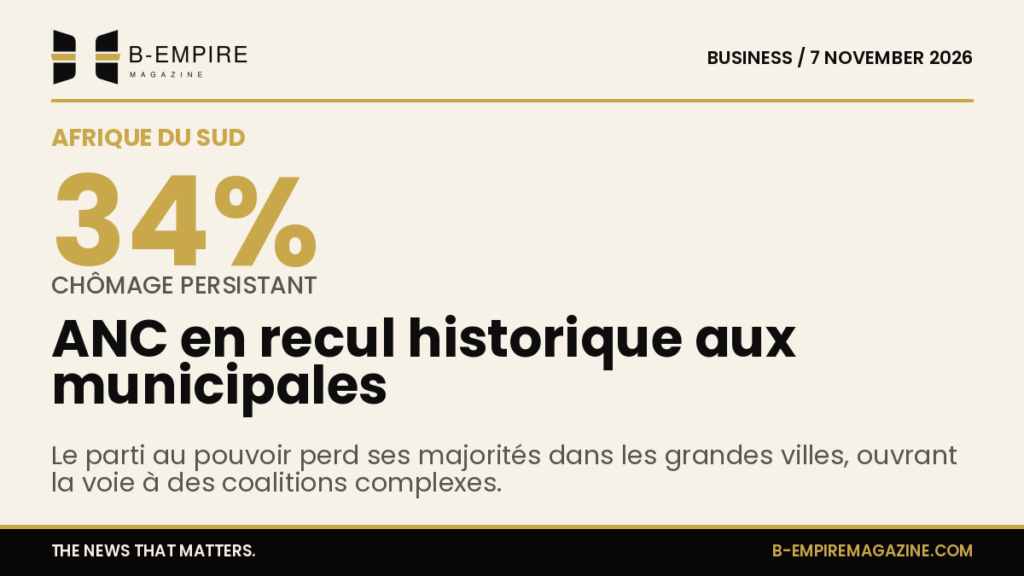
Partial results from South Africa's local elections reveal significant losses for the ruling ANC, which is set to lose outright majorities in major metros including Johannesburg and Pretoria. The Democratic Alliance gains ground, while the new uMkhonto weSizwe party emerges as a key player. The fragmented vote will lead to complex coalition talks amid voter frustration over corruption and unemployment.
Brève Publié le (Africa/Lagos, UTC+1)
South Africa’s African National Congress (ANC) is facing historic losses in the 2026 local elections, with partial results showing it will fail to secure outright majorities in any of the country’s eight major metropolitan areas, including Johannesburg and Pretoria.
With nearly 31% of votes counted out of 90%, the ANC, though still the largest party, has seen its support erode amid growing voter frustration over corruption and persistent unemployment rates exceeding 34%, more than three decades after apartheid ended.
The centre-right Democratic Alliance (DA) has increased its share to about a quarter of the vote, gaining ground in urban centers such as Johannesburg, where veteran politician Helen Zille leads the mayoral race.
Newly formed in 2023, the uMkhonto weSizwe (MK) party, led by former president Jacob Zuma, is contesting for the first time and is poised to finish third nationally, surpassing the Economic Freedom Fighters. Analysts attribute MK’s rise to the fragmentation of the ANC vote.
As no party is expected to win outright majorities, complex coalition negotiations are anticipated to form local governments. However, such coalitions have historically been unstable, often hampering effective service delivery.
Political analyst Daniel Silke highlighted that in Gauteng province, voters may prefer a DA-ActionSA coalition, but intense animosity between these parties could complicate negotiations.
Voter turnout increased to an estimated 54.5% of the 29.2 million registered voters, up from 46% in 2021. Final results are expected soon, with the election outcome marking a significant moment in South Africa’s political landscape.