
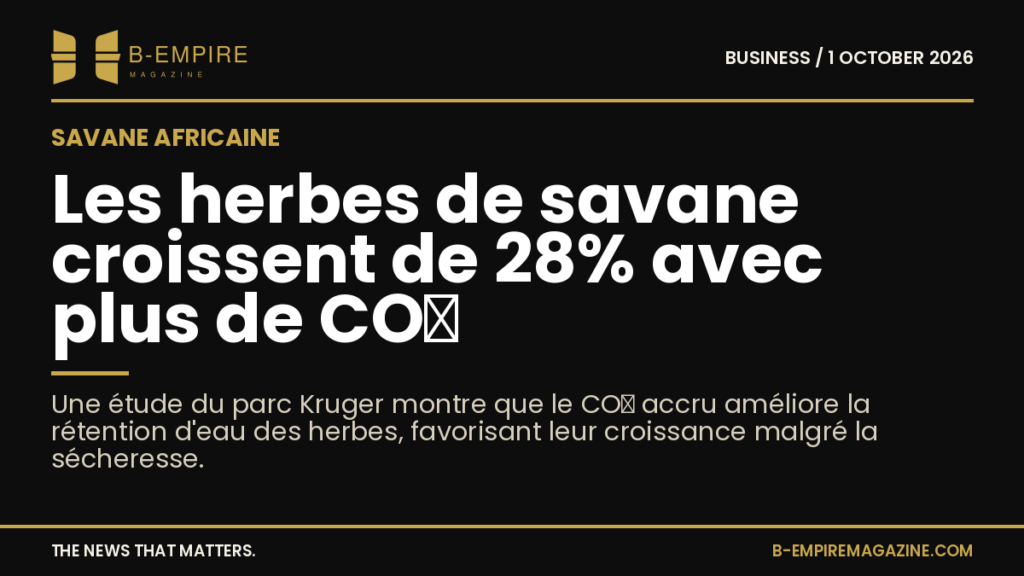
African savanna grasses grow 28% more with increased CO₂, research shows
A recent study reveals that rising atmospheric CO₂ levels have increased grass growth in African savannas by 28% over three decades, based on data from South Africa's Kruger National Park. This growth boost, driven by improved water retention under drier conditions, has significant implications for grazing, fire dynamics, and carbon storage in savanna ecosystems that cover half of Africa.
Brève Publié le (Africa/Lagos, UTC+1)
Rising atmospheric carbon dioxide (CO₂) levels have led to a 28% increase in grass production in African savannas over the past three decades, according to research analyzing data from South Africa’s Kruger National Park.
Scientists studied 70 experiments on wild C4 savanna grasses and analyzed 32 years of field data from 533 sites within the park, a region dominated by these grasses. Despite prior assumptions that C4 grasses would show limited response to higher CO₂, the findings reveal that increased CO₂ enhances water retention in grasses, allowing them to grow more even under dry conditions.
This growth boost is projected to continue as CO₂ levels rise further, even amid hotter and drier climates. Given that savannas cover about half of Africa, these changes could affect food availability for wildlife and livestock, alter fire fuel loads, and influence carbon storage in these ecosystems.