
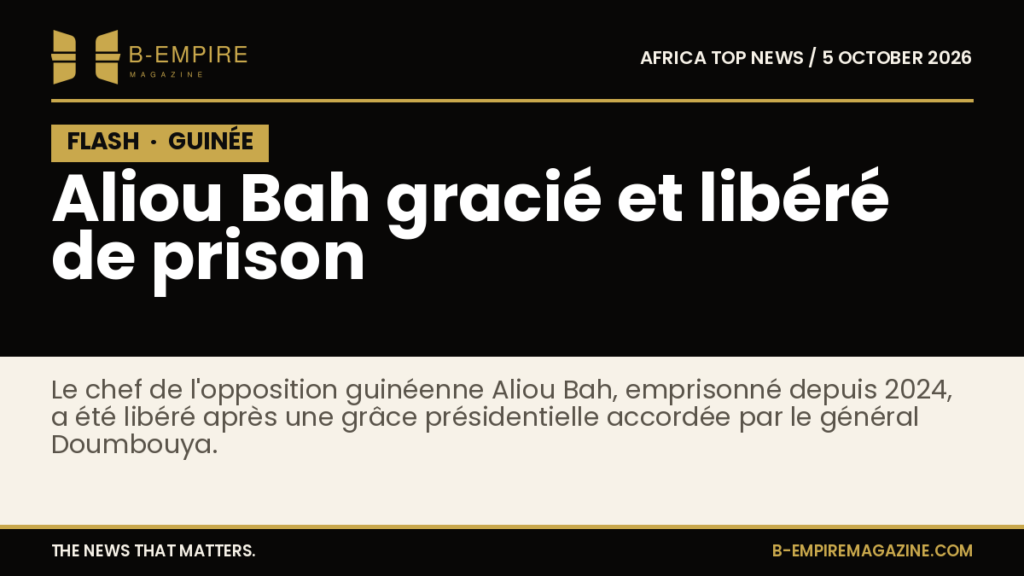
Aliou Bah, Guinea opposition head, granted pardon and released from prison
Guinea's opposition politician Aliou Bah was released from prison after nearly two years, following a presidential pardon granted by junta leader General Mamadi Doumbouya. Bah had been jailed for insulting the military ruler and was sentenced to two years in 2025. His release comes amid accusations of political repression by Guinea's military government since its 2021 coup.
Brève Publié le (Africa/Lagos, UTC+1) · date de l'événement : 2026-10-02
Guinean opposition leader Aliou Bah was freed on October 2, 2026, after nearly two years in prison, following a presidential pardon granted by junta leader General Mamadi Doumbouya. Bah, head of the Liberal Democratic Movement (Model), had been jailed since December 2024 for insulting Doumbouya and was sentenced to two years in January 2025.
The pardon was part of a broader release of 217 prisoners to mark Guinea’s Independence Day, announced on state television by presidency secretary-general Amara Camara. Bah’s release had not been expected until December 2026, but the presidential decree expedited his freedom.
Bah was convicted for remarks urging Guinean religious leaders to speak out against the political situation and criticizing the ruling National Committee of Rally for Development (CNRD) as “incompetent.” His case reached the Court of Justice of the Economic Community of West African States (ECOWAS), which in September 2026 called for his immediate and unconditional release.
Since seizing power in September 2021 by overthrowing President Alpha Conde, General Doumbouya’s military junta has faced accusations from opposition parties and rights groups of suppressing political freedoms. Several opposition parties have been dissolved, protests banned or violently dispersed, and critics arrested or forced into exile.
Bah’s release is a significant development in Guinea’s political landscape, signaling a possible, albeit limited, easing of repression by the military rulers ahead of ongoing regional and international pressure.