
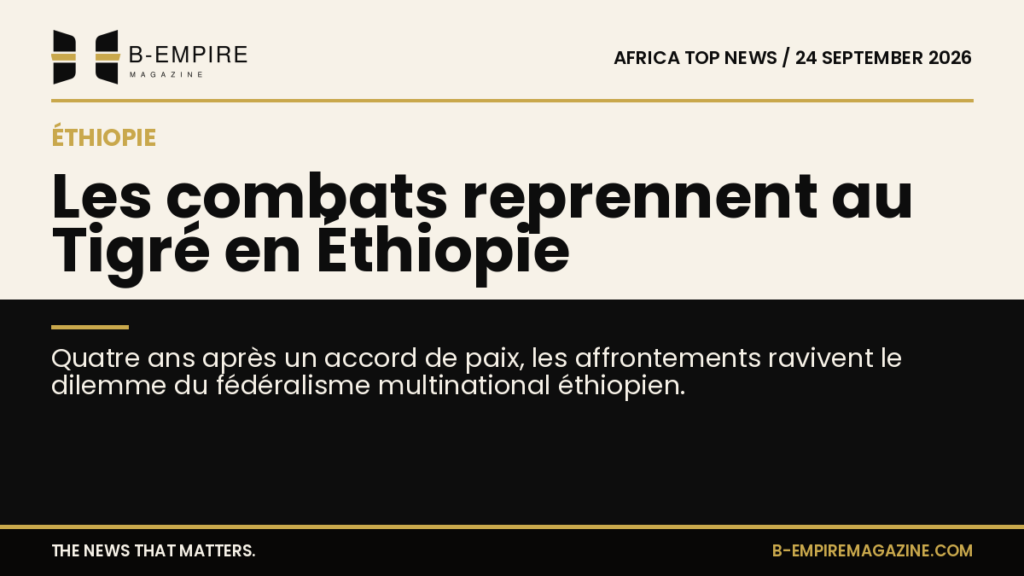
Fighting resumes in Ethiopia’s Tigray region, raising federalism dilemma anew
Nearly four years after a peace deal ended the Tigray war, renewed fighting in Ethiopia's Tigray, Afar, and Amhara regions underscores the challenges of Ethiopia's multinational federalism. The 1995 constitution grants ethnic groups rights to self-determination, complicating relations between regional autonomy and federal authority. The conflict highlights the difficulty of balancing ethnic identity, territorial control, and political power in Ethiopia.
Brève Publié le (Africa/Lagos, UTC+1)
Nearly four years after a peace agreement ended Ethiopia’s devastating war in Tigray, fighting has erupted again, with Tigrayan forces seizing airports and clashes reported in Tigray and neighboring Afar and Amhara regions, according to Ethiopian officials.
Tigrayan authorities claim they are responding to federal attacks, while the federal government describes the Tigrayan military action as an offensive. Both sides accuse each other of triggering the latest escalation, shattering the relative calm since the November 2022 peace agreement and raising fears of a wider conflict.
The crisis exposes Ethiopia’s complex multinational federalism system, established in the 1990s after the fall of the Mengistu regime. The 1995 constitution divided Ethiopia into regional states, recognizing the rights of its “nations, nationalities and peoples,” including self-determination and constitutional secession rights under Article 39.
This federal arrangement aimed to acknowledge Ethiopia’s ethnic diversity by granting regional autonomy based on language, identity, and settlement patterns. However, it also ties political authority closely to territory and ethnic identity, making disputes over regional boundaries highly sensitive and linked to political representation and security concerns.
Governance analysts note that while federalism does not inherently cause conflict, it complicates the relationship between political power, territory, identity, and resource access. The current fighting between Addis Ababa and the Tigray People’s Liberation Front (TPLF), once dominant in Ethiopia’s ruling coalition, exemplifies the tensions when regional autonomy clashes with central authority.