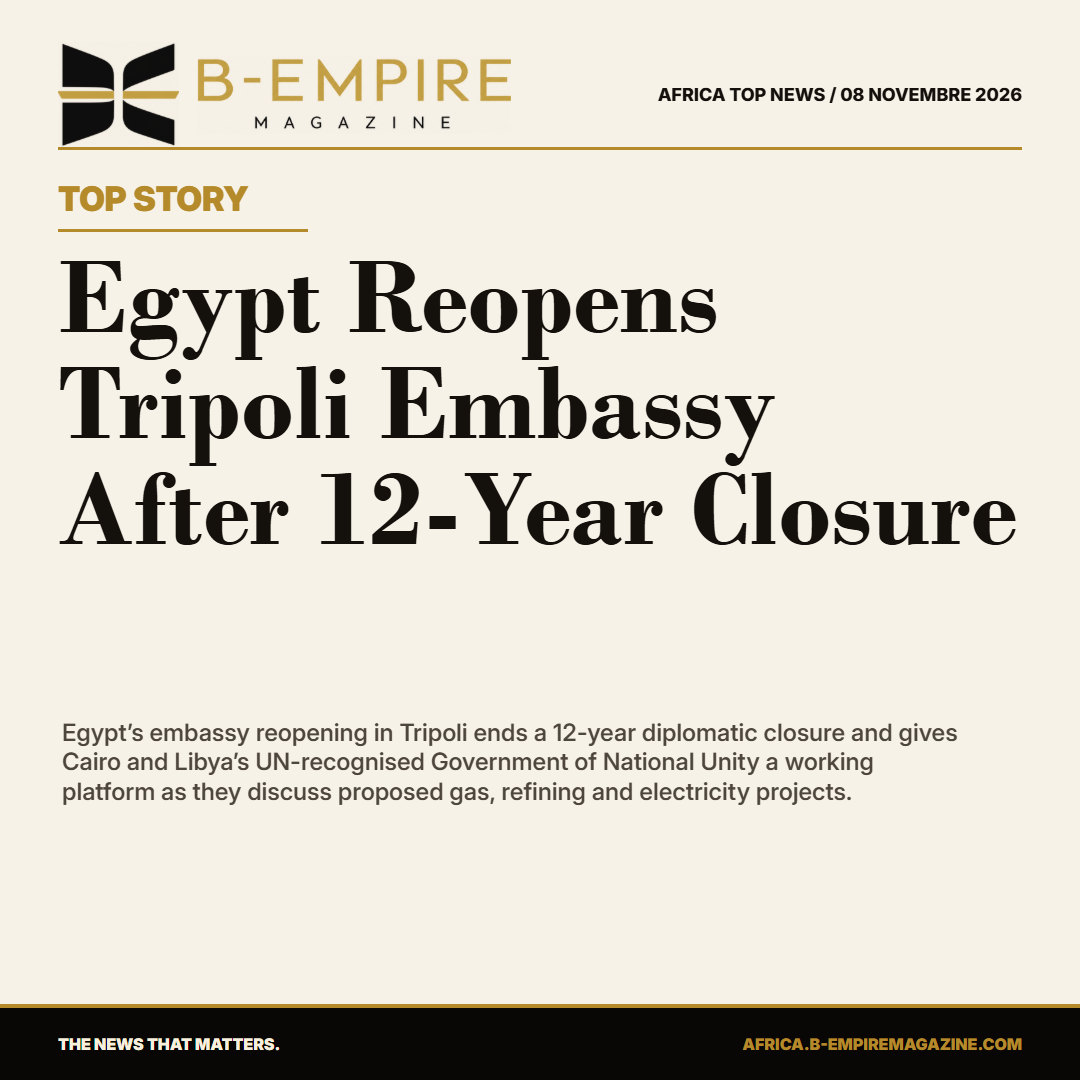
Egypt Reopens Tripoli Embassy After 12-Year Closure
Egypt’s embassy reopening in Tripoli ends a 12-year diplomatic closure and gives Cairo and Libya’s UN-recognised Government of National Unity a working platform as they discuss proposed gas, refining and electricity projects.
Egypt has reopened its embassy in Tripoli, ending a diplomatic closure that began in 2012 and creating a visible new channel for engagement with Libya’s capital. The move, announced during Foreign Minister Badr Abdelatty’s visit on Saturday, comes alongside renewed discussion of energy cooperation, including proposed gas links, refining and electricity interconnection. It is an important diplomatic development, but not proof that the two countries’ complex political and commercial challenges have been resolved.
A diplomatic presence returns to Tripoli
The reopening puts an Egyptian diplomatic mission back in Tripoli after more than a decade away. Cairo’s foreign minister attended the opening and met Libya’s Government of National Unity (GNU) officials, including Acting Oil and Gas Minister Khalifa Al-Sadiq, according to the Libyan News Agency. The embassy is a practical instrument: it can support regular official contact, consular work and business engagement on the ground, rather than relying solely on visits or communication through other channels.
The context matters. Libya remains politically divided, with rival administrations competing for authority. Egypt has historically maintained relationships across Libya’s political landscape, including with eastern-based actors. Renewed engagement in Tripoli therefore signals a broader effort to keep working relationships open. It should not be read as evidence that Libya’s institutional division has ended or that Cairo has abandoned other channels.
For both sides, a resident diplomatic presence can make routine coordination easier. Officials and companies need dependable points of contact to discuss visas, security, contracts, transport and technical cooperation. Yet an embassy by itself cannot settle disputes, guarantee project financing or create the stable regulatory conditions investors require. Its significance lies in opening a door and keeping it available.
Energy proposals move onto the agenda
The reopening coincided with a substantive energy discussion. LANA reported that Abdelatty and Al-Sadiq discussed connecting gas pipelines, expanding cooperation in petroleum products, refining Libyan crude in Egypt for re-export, rehabilitating Libyan refineries and completing electricity interconnection projects. The Egyptian minister also described the need to move from discussion toward technical implementation. These are proposals and workstreams, not a list of completed projects.
The ideas reflect complementary assets and needs. Libya has substantial hydrocarbon resources, while Egypt has an established energy infrastructure and processing capacity. In principle, closer coordination could offer Libya additional routes for processing and export and give both countries a reason to maintain regular technical dialogue. Electricity links, if developed, could also support cross-border exchange and improve the resilience of interconnected systems.
But the route from political statement to operating infrastructure is long. Pipeline proposals require route studies, engineering, financing, agreements on tariffs and access, environmental review and security arrangements. Refining projects need clarity on crude specifications, commercial terms, ownership, capacity and the market for resulting products. Rehabilitating facilities inside Libya also depends on safe access, reliable equipment supply, skilled personnel and continuity of operations.
Electricity interconnection presents its own sequence of work: grid assessments, technical standards, transmission capacity, investment responsibilities and rules for balancing supply. Governments can set a direction, but utilities and technical teams must demonstrate that a project is feasible and economically worthwhile. Transparent milestones would help distinguish near-term actions, such as working groups and feasibility studies, from major construction decisions that may take years.
Why diplomatic continuity matters
The embassy can give these discussions a more durable institutional home. Energy partnerships involve more than ministers: they require regulators, state companies, engineers, financiers and private contractors to keep communicating as details are negotiated. A permanent mission can help maintain contact when political attention shifts and can help businesses understand the official process for raising questions or pursuing opportunities.
That continuity could be valuable in a region where projects can be affected by changing security conditions and political alignments. A functioning diplomatic channel does not remove those risks, but it may help both governments address them earlier. The difference between a headline announcement and a viable investment often comes down to repeated, specific follow-up: named technical counterparts, agreed data, realistic schedules and written responsibilities.
For Libya, the economic case will depend on whether cooperation supports national capacity and produces benefits that can be sustained. Refinery rehabilitation, for example, would be more meaningful if it improves reliable domestic operations and is accompanied by clear commercial arrangements. For Egypt, any cross-border energy investment must make sense on its own economics and account for security, supply and market risks. Both sides would need agreements robust enough to outlast individual meetings.
What to watch next
The immediate test is not a ceremonial milestone but the follow-through. LANA reported that Al-Sadiq said he would visit Cairo to continue technical discussions with Egypt’s petroleum and electricity ministers. Such a visit could provide an opportunity to establish working groups and identify which proposals are ready for feasibility work. Publicly stated timelines, studies or signed technical memoranda would offer stronger evidence of progress than broad expressions of intent.
Observers should also watch for details on the embassy’s operational capacity, the level of consular and commercial services it can provide, and the range of Libyan institutions involved in the energy talks. Because Libya has competing centres of power, durable projects will need to navigate national institutions and political realities carefully. Coordination that is transparent and inclusive is more likely to support continuity than arrangements that depend on a narrow set of contacts.
For now, the clearest fact is the reopening itself: Egypt has restored a diplomatic presence in Tripoli after 12 years. The associated energy agenda gives that move an economic dimension, but the pipeline, refining and electricity concepts remain proposals whose viability must be established. A reopened embassy creates access; whether that access leads to bankable projects and stable cooperation will depend on technical work, security and sustained political engagement.
Sources
- Africanews / AFP: Egypt reopens embassy in Libya as it seeks to rebuild energy ties
- Libyan News Agency: Acting Oil Minister meets Egyptian Foreign Minister
- Egyptian State Information Service: FM discusses energy cooperation with Libyan counterpart
- Ahram Online: Egypt-Libya energy cooperation discussions