Congo’s Tear-Gas Protests Put the Third-Term Question Back in Focus
The latest Congo protests over constitutional change are a test of term limits, opposition unity and state restraint in a country already under security and health pressure.
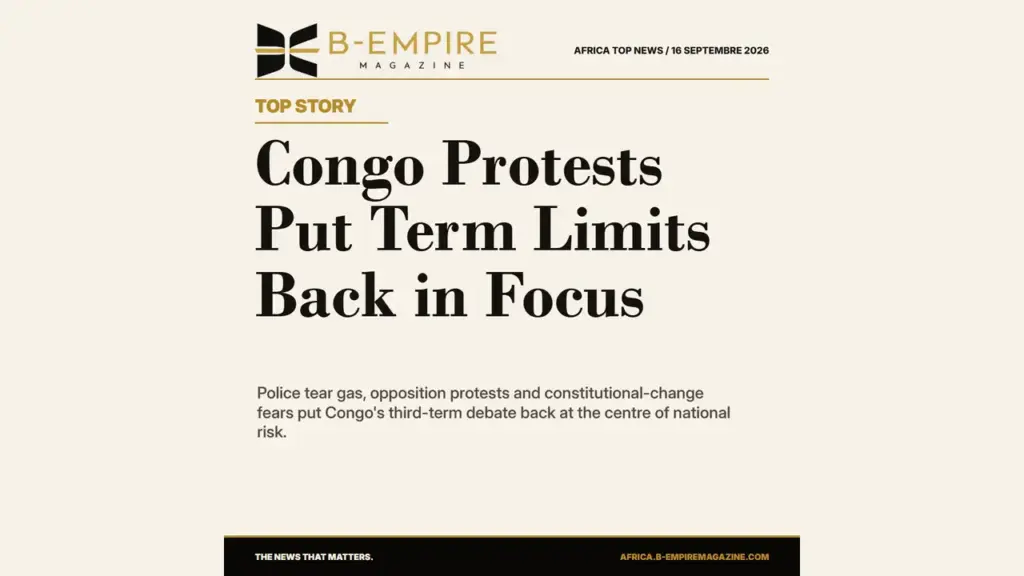
Police in the Democratic Republic of Congo fired tear gas and warning shots on Tuesday to disperse opposition protests against proposed constitutional changes that critics say could open a path for President Felix Tshisekedi to seek a third term. The demonstrations, called by the C64 opposition coalition, took place in Kinshasa and other cities including Lubumbashi and Kindu, despite restrictions on mass gatherings linked to the country’s fast-spreading Ebola outbreak.
The confrontation puts Congo’s term-limit debate back at the centre of national risk. Tshisekedi, who has been in office since 2019 and is due to finish his second term in 2028, has said he would be willing to seek a third term if voters approve it in a referendum. Congo’s current constitution bars revision of presidential term limits, but a bill under consideration in the National Assembly would allow the president to amend those provisions in the event of a major dysfunction that paralyzes state institutions, potentially after a referendum.
The opposition argues that the bill is not a technical fix but a political opening. C64, or Coalition Article 64, was formed in May by opposition forces that had been divided in recent years. It includes figures linked to Martin Fayulu, Moise Katumbi and Delly Sesanga, and frames itself as a defence of the constitutional order. Its central claim is simple: term limits are not a bargaining chip.
What happened in Kinshasa
The Kinshasa protest reportedly began peacefully, drawing hundreds of demonstrators, before clashes broke out between opposition protesters and pro-government supporters. Police then used tear gas and warning shots to disperse the crowd. Associated Press reported opposition leader Martin Fayulu accusing the state of working with a political-party militia and saying he escaped a violent crackdown. Government spokesperson Patrick Muyaya accused the opposition of misinformation and disruption while saying the right to protest must be exercised properly.
Reuters witnesses reported that demonstrations were also dispersed in other cities, including Lubumbashi and Uvira, where local authorities had prohibited protests. The picture is therefore not only one of a single Kinshasa confrontation. It is a national political test at a moment when the government is already under strain from conflict in the east, public-health restrictions and a tense parliamentary calendar.
Police also dispersed a C64 rally in June, when protesters opposed earlier constitutional manoeuvres. Human Rights Watch later said security forces had used excessive force and failed to protect demonstrators from assailants. That history matters because Tuesday’s events are part of a pattern. The state is not responding to a one-off protest; it is responding to a growing opposition campaign around constitutional limits.
The third-term shadow
In African politics, term-limit debates are rarely only legal questions. They are tests of trust. A government may argue that constitutional reform is needed to correct institutional dysfunction. Opponents may see the same reform as a route to extend power. The gap between those views becomes dangerous when institutions are weak, political trust is low and security forces are used to manage dissent.
Congo’s constitution currently contains provisions that protect presidential term limits from revision. That design reflects the country’s difficult political history. Term limits are meant to prevent incumbency from becoming permanent rule. Any attempt to revise or bypass them therefore carries heavy symbolic weight, even if framed as a referendum or institutional repair.
The phrase major dysfunction is especially sensitive. If broad or poorly defined, it could become a legal doorway for exceptional politics. Opposition groups fear that an undefined crisis could be used to reset political rules before 2028. Supporters of reform may argue that state paralysis requires flexibility. But in a country with deep conflict and fragile institutions, exceptional clauses must be treated carefully.
A country already under pressure
The protests come while Congo is dealing with multiple crises. Eastern provinces remain affected by armed groups, including the Rwanda-backed M23 rebellion and many other militias competing for territory, resources and influence. The Ebola outbreak has placed additional restrictions on public gatherings and movement. Economic pressures, displacement and mistrust of institutions add to the volatile environment.
This context cuts both ways. The government can argue that public gatherings during an Ebola outbreak and insecurity create public-order risks. The opposition can argue that emergencies should not be used to silence constitutional dissent. Both concerns cannot be dismissed lightly. Public health matters. So does the right to protest. The test is whether restrictions are necessary, proportionate and applied without political bias.
If the state relies heavily on dispersal, tear gas and warning shots, it risks escalating political grievance. If the opposition dismisses all restrictions as illegitimate, it risks feeding confrontation during a public-health emergency. Congo needs political management that lowers temperature, not one that turns every protest into a security event.
Opposition unity and its limits
C64’s formation matters because Congo’s opposition has often been fragmented. Fayulu, Katumbi and other opposition figures have not always moved in the same direction. A shared defence of constitutional term limits gives them a unifying theme that can reach beyond party lines. Actualite.cd reported in August that C64 called for the 15 September mobilisation as a national action against what it sees as an attempt to bypass constitutional protections.
Unity around what the opposition rejects does not automatically produce unity around what it proposes. That will be the next test. If C64 remains only an anti-third-term front, it may mobilise anger but struggle to become a governing alternative. If it can connect constitutional defence to security, public services, economic reform and accountability, it may become a stronger political force.
The government will watch that carefully. A divided opposition is easier to manage. A coalition centred on constitutional defence is harder to dismiss, especially if it can frame itself as protecting the republic rather than merely competing for power.
Democratic risk and investor risk
Congo’s political stability matters far beyond Kinshasa. The country is central to global cobalt and copper supply chains, regional security and central African geopolitics. Investors in mining, energy and infrastructure watch political risk closely. So do neighbouring states, donors and humanitarian agencies. A term-limit crisis would not remain a domestic legal debate for long.
Democratic uncertainty can raise the cost of capital, slow projects and weaken public trust in contracts and institutions. It can also deepen regional fragility if political tensions in Kinshasa distract from eastern security, Ebola response and governance of natural resources. Congo cannot afford a constitutional crisis layered on top of its existing emergencies.
That is why the term-limit question is not abstract. It affects the state’s ability to govern, negotiate and maintain legitimacy. A government that wants investor confidence and national unity should avoid reforms that appear to weaken constitutional guarantees. An opposition that wants stability should defend rights while avoiding escalation that exposes civilians to unnecessary risk.
What to watch next
The first indicator is how the National Assembly handles the bill. If lawmakers press ahead without broad consultation, tensions are likely to rise. If the process slows for dialogue and clarification, the temperature could ease.
The second indicator is the treatment of protest rights. Arrests, injuries or further bans would signal a harder security line. Authorization of peaceful protests under clear health and safety conditions would indicate a more balanced approach.
The third indicator is whether C64 remains united after Tuesday’s mobilisation. Opposition coalitions often fracture under pressure, especially when leadership ambitions differ. A sustained, disciplined campaign would change the political landscape.
The fourth indicator is the role of churches and civil society. Congo’s Catholic Church and civic groups have historically shaped constitutional debates. Their position could influence public legitimacy on both sides.
The fifth indicator is the Ebola context. If public-health restrictions are applied unevenly, the opposition will argue that health rules are being politicised. If restrictions are transparent and consistent, they may reduce that accusation.
The bottom line
Congo’s tear-gas protests are a warning signal. The country is approaching a constitutional argument that could become a national legitimacy crisis if handled carelessly. Term limits are not simply legal clauses. They are guardrails in a political system that has already endured conflict, contested transitions and institutional mistrust.
The government says protest rights must be exercised properly. The opposition says the constitution must not be opened to a third term. Both claims now face a practical test: can Congo manage political disagreement without violence, manipulation or emergency logic swallowing democratic space?
The answer will shape more than the 2028 election. It will affect Congo’s stability, its reform agenda, its regional role and the trust citizens place in the constitution itself. The next steps in parliament and on the streets will show whether the country is moving toward dialogue or deeper confrontation.
Sources
- Associated Press – Police fire tear gas to break up Congo protests against constitutional changes, 15 September 2026
- Reuters via Internazionale – Congo police break up protests against proposed constitutional changes, 15 September 2026
- Local10 / Associated Press – Congo protests and government response, 15 September 2026
- Human Rights Watch – DR Congo: Crackdown on protesters, 9 July 2026
- Actualite.cd – C64 announces 15 September march against constitutional change, 15 August 2026