
Dangote Refinery IPO Opens a New Test for African Capital Markets
Dangote Refinery's public offer opens with a retail-friendly entry point, turning Africa's largest refinery into a major test for Nigerian investors, capital markets and industrial finance.
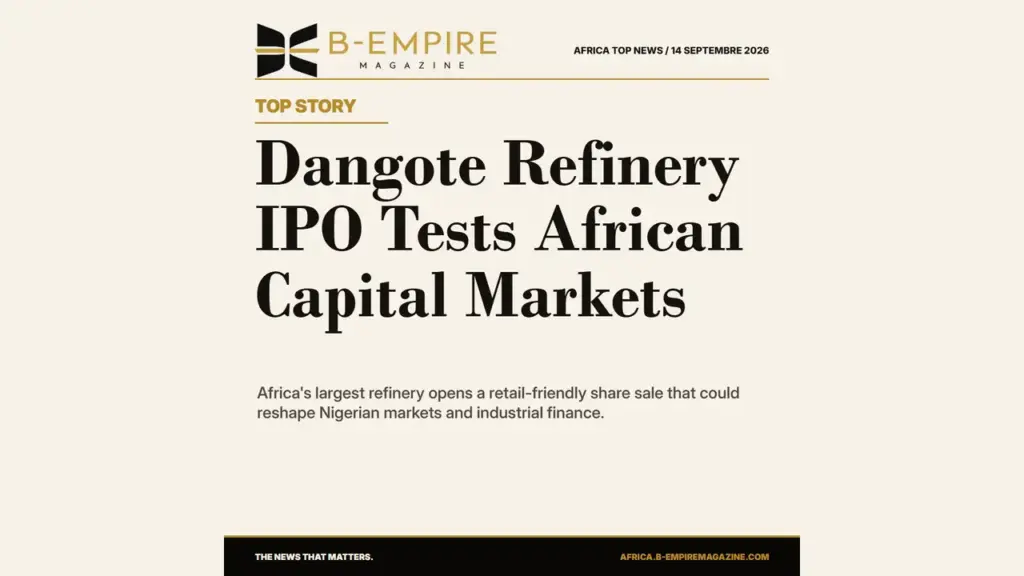
Dangote Petroleum Refinery and Petrochemicals opens its public share offer on September 14, turning one of Africa’s largest industrial assets into a live test of Nigerian retail demand, market depth and confidence in African industrial finance. The official IPO portal lists an offer price of N525 per share, a minimum subscription of 10 shares, an opening date of September 14 and a closing date of October 13. For ordinary investors, the minimum entry point is therefore N5,250.
The scale is what makes the transaction consequential. The offer covers 4.1 billion ordinary shares and could raise about N2.15 trillion if fully subscribed, according to Nigerian market reports and the official offer information. The Financial Times described the deal as potentially Africa’s largest IPO, with a value that places the refinery among the most important industrial companies on the continent. That does not make the offer risk-free. It makes it a signal. Nigeria is asking whether local and pan-African investors will buy into an asset that has already changed the country’s fuel market and could reshape the Nigerian Exchange if listed successfully.
The public offer arrives after a signing ceremony in Lagos and follows regulatory approval of the main offer terms. Premium Times and Nairametrics reported that Aliko Dangote confirmed the minimum subscription during the offer-document signing, while several African business outlets highlighted the structure’s deliberate retail orientation. The messaging is clear: this is not being framed only as a transaction for large institutions. It is being sold as a way for ordinary eligible investors to own a stake in a refinery that has become a symbol of African industrial ambition.
Why the timing matters
The timing is important because the refinery has moved from promise to operating reality. The Lekki complex began operations in 2024 and has become central to Nigeria’s effort to reduce dependence on imported refined fuel. For decades, Africa’s largest oil producer faced the uncomfortable paradox of exporting crude while importing large volumes of petrol, diesel, aviation fuel and other refined products. That structure drained foreign exchange, exposed households to shortages and made fuel policy politically explosive.
Dangote’s refinery did not solve every problem in Nigeria’s energy system. Crude supply, pricing, regulation, logistics and currency pressure remain difficult. But the refinery changed the direction of the conversation. Nigeria now has a domestic industrial platform capable of processing hundreds of thousands of barrels per day and supplying local and export markets. A public offer linked to that asset therefore carries more weight than a normal listing. Investors are not only buying a company story. They are buying a view on Nigerian energy reform, African fuel demand and the future of local processing.
The offer also opens while African capital markets are searching for larger, more investable stories. Many exchanges on the continent struggle with shallow liquidity, limited new listings and a narrow set of investable sectors. A large industrial IPO can attract attention, but it also raises the bar. If the market absorbs it well, other African companies may see public markets as a serious route for expansion capital. If demand disappoints, the lesson could be harsher: even landmark assets may struggle to mobilise broad equity participation at scale.
A retail-friendly offer with real risks
The low minimum subscription is one of the most striking features. At 10 shares, the official entry point is designed to be accessible to many Nigerian households. That retail framing matters politically and commercially. It gives the transaction a mass-market identity and allows the company to present the offer as a participation opportunity rather than only a capital raise.
But a low entry point should not hide investment risk. The official IPO website warns investors to read the prospectus, use only approved subscription channels and avoid sharing passwords, PINs or one-time codes. That warning is not routine decoration. A high-profile IPO can attract fraudsters, fake allocation schemes and social-media promotions promising guaranteed returns. Retail participation is valuable only if investors understand that shares can rise or fall and that allotment, liquidity and future dividends are not automatic.
For Nigeria’s regulators and market operators, this is a conduct test as much as a listing test. The Securities and Exchange Commission, issuing houses, receiving agents, brokers and digital application platforms will be judged by how clearly they protect investors, process subscriptions and prevent misinformation. A successful IPO should not be measured only by money raised. It should also be measured by whether ordinary investors are treated transparently.
The refinery as a national market asset
The potential listing could change the Nigerian Exchange’s profile. Large listings matter because they can deepen market capitalisation, attract institutional investors and create new benchmarks for valuation. Nigeria’s equity market has strong banks, consumer companies and telecom exposure, but a major refinery listing would add a different kind of industrial and energy weight.
That can be positive if it broadens the market. It can also concentrate attention around one very large asset. Investors will need to examine revenue sources, feedstock arrangements, debt levels, governance, related-party structures, regulatory exposure and expansion plans. The refinery’s size is impressive, but size alone does not answer questions about margins, crude access, foreign-exchange needs or policy risk.
Fuel markets are politically sensitive in Nigeria. Pricing decisions affect inflation, transport costs and household welfare. The refinery operates inside a policy environment where government, regulators, marketers, unions and consumers all have stakes. Shareholders will therefore be exposed not only to business performance, but also to the politics of energy affordability.
A continental industrial signal
The IPO has significance beyond Nigeria because it speaks to a broader African question: can the continent finance industrial assets at home? Africa has long exported raw materials and imported finished goods. That model weakens currencies, limits jobs and leaves value addition elsewhere. The Dangote refinery represents a different ambition: process more on the continent, build scale, compete regionally and capture more of the value chain.
If the offer succeeds, it could reinforce the idea that African capital markets can support heavy industry, not only banks, telecoms and consumer stocks. It could also encourage other large African groups to consider public listings as a way to broaden ownership and finance expansion. That would be healthy if governance standards rise with the capital raised.
The continental angle is also practical. The refinery’s products are already tied to regional supply chains, and the company has signalled broader African ambitions, including infrastructure and refinery plans outside Nigeria. Investors will watch whether IPO proceeds support expansion that strengthens African fuel security or simply adds financial complexity to an already massive project.
What investors should watch
The first thing to watch is subscription quality. A fully subscribed offer is useful, but the composition of demand matters. Strong participation from long-term domestic institutions, credible foreign investors and broad retail buyers would send a stronger signal than demand driven by short-term speculation.
The second issue is disclosure. Investors need clear information on production volumes, crude supply, offtake contracts, debt, expansion costs, foreign-currency exposure, tax treatment and governance. A refinery is not a simple business. Its profitability can depend on crack spreads, feedstock terms, logistics, regulatory rules and geopolitical shocks. The prospectus will therefore be central to informed participation.
The third issue is post-listing liquidity. A successful offer day does not guarantee an efficient market after listing. Investors need the ability to buy and sell shares without extreme spreads or thin trading. Market makers, institutional participation and strong public information will matter.
The fourth issue is whether the transaction changes behaviour in Nigerian capital markets. If companies see that serious disclosure and public ownership can unlock capital, the IPO could have a demonstration effect. If the market treats the offer mainly as a one-off personality-driven event, the systemic benefit will be smaller.
The bottom line
Dangote Refinery’s IPO is more than a share sale. It is a test of whether Africa’s largest economy can turn a landmark industrial asset into a broader capital-market event. The low minimum subscription gives the offer a popular face. The scale gives it institutional weight. The refinery’s role in Nigeria’s fuel market gives it strategic importance.
The opportunity is large, but so are the questions. Investors should not confuse national pride with investment certainty. Regulators should not confuse retail access with investor protection. And African policymakers should not confuse one successful refinery with a completed industrialisation strategy. Still, the offer matters because it places a real African industrial asset at the centre of public-market finance. If managed well, it could widen ownership, deepen Nigeria’s exchange and strengthen the case for financing more of Africa’s transformation on African markets.
Sources
- Official Dangote IPO portal – offer price, minimum subscription and offer dates
- Financial Times – Africa’s richest man seeks to raise $1.6bn in continent’s biggest IPO, 8 September 2026
- Premium Times – Dangote Refinery sets minimum subscription for $1.6 billion IPO, 7 September 2026
- Nairametrics – Dangote Refinery sets N5,250 minimum subscription for IPO, 7 September 2026
- People Daily – Dangote Refinery IPO opens September 14, 8 September 2026