
Africa Green Hydrogen Summit Tests the Leap From Pipeline to Gigawatts
The Africa Green Hydrogen Summit in Cape Town is a test of whether the continent can move from clean-energy ambition to bankable projects, jobs and industrial value.
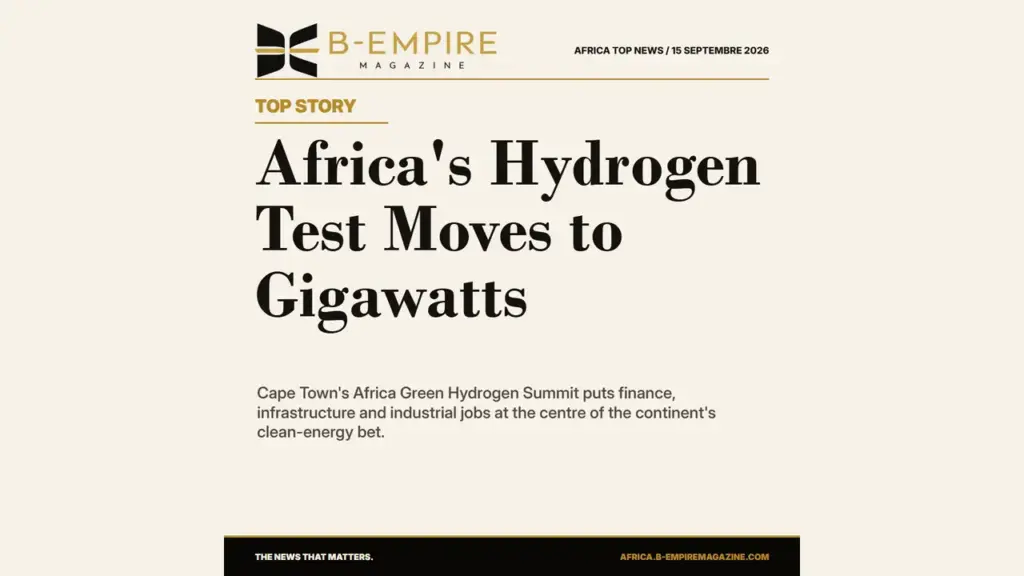
The Africa Green Hydrogen Summit 2026 opens in Cape Town on Tuesday, 15 September, with a theme that captures both the opportunity and the frustration around the continent’s clean-energy ambitions: moving Africa’s green hydrogen sector from PowerPoint to gigawatts. President Cyril Ramaphosa is scheduled to deliver the keynote address virtually, while Electricity and Energy Minister Kgosientsho Ramokgopa hosts the two-day gathering of African governments, investors, technology companies, academics and civil-society actors.
The summit arrives at an important moment. Africa has some of the world’s best solar and wind resources, large tracts of land, critical minerals, port access and growing industrial demand. Those advantages make the continent a credible candidate for green hydrogen and Power-to-X production. But the distance between potential and bankable projects remains wide. Developers need offtake agreements, transmission, water planning, ports, skills, blended finance, certification rules and public support before hydrogen projects can move beyond announcements.
That is why the summit’s focus on implementation matters. Africa does not need another clean-energy conference that celebrates resource maps and future export markets without confronting delivery. The continent needs a realistic conversation about what it takes to finance, build and operate hydrogen projects that create local value instead of repeating an extractive model under a green label.
Why green hydrogen is strategic
Green hydrogen is produced by using renewable electricity to split water into hydrogen and oxygen. It can then be used directly or converted into derivatives such as ammonia, methanol, synthetic fuels and green fertiliser. Its most important role is likely to be in sectors that are difficult to electrify: heavy industry, shipping, aviation, chemicals, mining and some forms of long-distance transport.
For Africa, green hydrogen offers three possible benefits. The first is export revenue. Europe, Japan, South Korea and other industrial regions are looking for low-carbon fuels and industrial inputs. African countries with strong renewable resources and coastal access could compete as suppliers if they can meet cost, certification and reliability requirements.
The second benefit is domestic industrialisation. Hydrogen can support green steel, green fertiliser, mining decarbonisation and chemicals. This is where the agenda becomes more interesting than simple energy exports. If African countries use hydrogen to process minerals, manufacture inputs and build industrial clusters, the sector could support jobs and technology capability.
The third benefit is energy-system development. Large hydrogen projects require renewable generation, grid upgrades, water infrastructure, ports, storage, pipelines and specialist services. If planned well, some of that infrastructure can benefit wider economies. If planned poorly, it can become an export enclave disconnected from local needs.
The South African platform
South Africa is a natural host for the summit because it has policy architecture, industrial demand and mineral endowments that connect directly to the hydrogen value chain. Its Hydrogen Society Roadmap, Green Hydrogen Commercialisation Strategy and Just Energy Transition framework all place hydrogen inside a broader industrial policy. The country also has platinum-group metals, which are relevant to fuel cells and electrolysers, as well as ports, mining customers and existing industrial corridors.
But South Africa also illustrates the challenge. Its electricity system has spent years under pressure from load shedding, coal-fleet instability and grid constraints. Hydrogen cannot scale if renewable generation and transmission do not scale with it. A credible hydrogen economy therefore depends on fixing the basic energy system as much as promoting future fuels.
The summit is expected to showcase South African and wider African projects moving from development toward investment, construction and commercial deployment. That shift is essential. The global hydrogen race is becoming more disciplined. Investors want to know which projects have land, permits, renewable power, water access, port plans, buyers and bankable contracts. A project pipeline is useful only when it is credible enough to finance.
Finance is the hard test
The central test is finance. Green hydrogen projects are capital-intensive and depend on complex value chains. A developer may need to build renewable generation, electrolyser capacity, water treatment, storage, transport links and export infrastructure before revenue is secure. That means private capital often wants public support, development finance or guarantees before it commits.
The summit’s emphasis on project preparation, blended finance and development-finance initiatives is therefore not a technical side issue. It is the core of the market. Many African projects fail not because the resource is weak, but because early-stage development is underfunded. Feasibility studies, environmental assessments, community engagement, engineering work and offtake negotiations all cost money long before a project reaches financial close.
Domestic capital also matters. If Africa’s hydrogen sector is financed only by foreign investors seeking export supply, the continent risks limited ownership of the value chain. Pension funds, insurers, banks and public investment institutions should be part of the financing architecture, with risk-sharing tools that make long-term infrastructure investable. African capital will not replace global capital, but it can change the balance of ownership and accountability.
The danger of export enclaves
The most serious risk is that green hydrogen becomes a new version of an old bargain: Africa supplies low-carbon inputs while others capture the higher industrial value. A hydrogen export terminal can create revenue, but if electrolyser components, specialised services, shipping, certification, financing and end-use manufacturing are controlled elsewhere, the local development impact may be narrow.
That is why green industrialisation must be more than a phrase. African countries need to ask hard questions. Will projects use local suppliers where possible? Will they train technicians and engineers? Will they support local manufacturing of renewable-energy components, electrolysers, fuel-cell parts or port equipment? Will communities near projects benefit through jobs, infrastructure and revenue-sharing? Will water use be managed transparently in water-stressed regions?
The just transition also matters. South Africa’s coal regions cannot be asked to accept clean-energy promises without credible jobs and retraining. Hydrogen can be part of the answer, but only if industrial policy links new projects to workers, communities and local firms. Otherwise, public scepticism will grow.
A continental project
The summit is African in scope, not only South African. Namibia has emerged as one of the continent’s most visible green-hydrogen markets, with major planned projects tied to export potential and industrial zones. Egypt and Morocco are positioning themselves around renewable energy, ports and proximity to Europe. Kenya has strong geothermal and renewable resources. Mauritania has large-scale wind and solar prospects. South Africa brings industrial demand and policy infrastructure. Together, these markets show why hydrogen could become a continental strategy rather than a single-country bet.
Regional cooperation will be essential. Certification rules, infrastructure corridors, port standards, local-content frameworks and power-market development will determine whether African countries complement one another or compete destructively for the same investors. The African Green Hydrogen Alliance can help if it moves from advocacy to coordination.
Africa also needs a stronger negotiating position in global hydrogen markets. Buyers in Europe and Asia may want secure low-carbon fuels, but African governments should avoid locking themselves into low-margin export contracts before domestic industrial options are fully examined. Hydrogen must support Africa’s development strategy, not only the decarbonisation targets of richer economies.
What to watch in Cape Town
The first thing to watch is whether the summit produces concrete project milestones. Announcements should be judged by permits, financing commitments, offtake agreements, construction timelines and infrastructure plans. The phrase from PowerPoint to gigawatts sets a high standard. It should not be allowed to become another slogan.
The second indicator is the role of African finance. If domestic and continental institutions are visible in project-preparation funds, guarantees and equity structures, the sector will look more grounded. If the conversation is dominated by external export buyers, the ownership question will remain unresolved.
The third indicator is local value. Green hydrogen will win public legitimacy only if it supports jobs, skills, manufacturing and infrastructure that people can see. Export revenue alone will not be enough, especially in countries facing unemployment, inequality and electricity access gaps.
The fourth indicator is demand creation. Hydrogen projects need buyers. Governments can support demand through green public procurement, industrial policy, transport decarbonisation, fertiliser strategies and mining partnerships. Without demand, supply-side ambition will remain fragile.
The bottom line
The Africa Green Hydrogen Summit 2026 is important because it frames the continent’s hydrogen debate around execution. Africa has the resources to matter in the global hydrogen economy, but resources alone do not build industries. The real work is finance, infrastructure, regulation, skills, local manufacturing and credible demand.
Cape Town’s summit can help if it pushes governments and investors toward bankable projects rather than abstract ambition. It can also help if it insists that hydrogen must serve African industrialisation, not only foreign decarbonisation. The continent’s green-energy future should not be measured only in exported molecules. It should be measured in jobs, factories, resilient infrastructure, cleaner industries and stronger negotiating power.
The phrase from PowerPoint to gigawatts is useful because it leaves little room for illusion. Africa’s hydrogen opportunity is real, but it will be judged by what gets built. The next phase must turn maps, memoranda and conference language into projects that carry power, capital and value through African economies.
Sources
- The Presidency of South Africa – President Ramaphosa to deliver keynote address at Africa Green Hydrogen Summit, 14 September 2026
- Department of Electricity and Energy – Minister Ramokgopa to host 2026 Africa Green Hydrogen Summit, 31 August 2026
- South African Government – Africa Green Hydrogen Summit media accreditation advisory, 10 September 2026
- Green Building Africa – Africa Green Hydrogen Summit 2026 to focus on turning projects into gigawatts, 11 September 2026
- GCIS – Cabinet statement approving South Africa’s hosting of the summit, 26 August 2026