
African economies face rising risks amid global uncertainty, IMF and World Bank warn
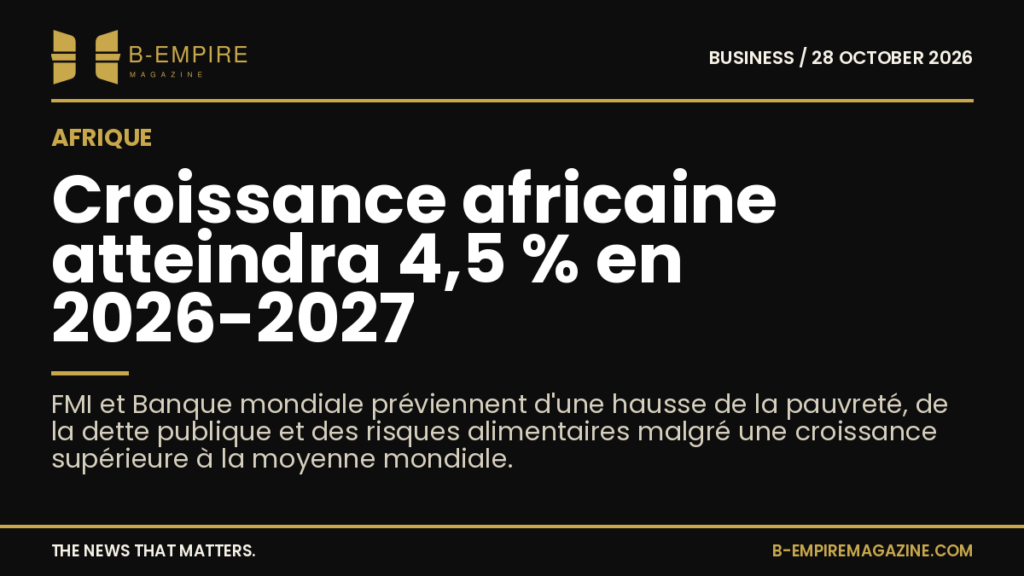
The IMF and World Bank forecast African economic growth of around 4.5% in 2026 and 2027, higher than global averages. However, they warn of rising poverty levels, increasing public debt, and food insecurity risks due to global inflation, supply shortages, and climate factors. Declining official development assistance and high debt servicing costs threaten Africa's capacity to meet development goals.
Brève Publié le (Africa/Lagos, UTC+1)
The International Monetary Fund (IMF) and the World Bank have forecast that African economies will grow around 4.5% in 2026 and 2027, outpacing the global growth estimates of 3.1% and 3.4% respectively. This growth is attributed to the macroeconomic reforms African countries implemented earlier in the century, which have helped them withstand shocks from conflicts such as the wars in Ukraine and the Gulf states.
Despite this optimistic growth outlook, the World Bank warns that poverty levels in Africa in 2027 will be higher than in 2022. Public debt in Africa has increased at about four times the rate of GDP growth since 2010, with governments spending an average of 12% of revenue on debt servicing—exceeding expenditures on health or education in many cases.
The IMF’s Africa department director has also cautioned that African countries face heightened risks of food insecurity and inflation due to rising fertilizer prices and the effects of El Niño. Furthermore, the continent is unlikely to raise the estimated US$4.1 trillion needed by 2030 to achieve Sustainable Development Goals and climate objectives.
External debt as a percentage of exports has doubled since 2010, now reaching 140%, with private creditors accounting for about 45% of sub-Saharan Africa’s debt. African countries often incur higher costs on this financing compared to other regions. Meanwhile, official development assistance has declined by 24% in 2025 from 2024 levels and is expected to fall further in 2026 and 2027, returning to 2015 real-term levels.
Multilateral development banks, including the World Bank and African Development Bank, are becoming increasingly important creditors for African nations. The World Bank is currently the largest creditor to sub-Saharan Africa and is working to increase financing availability.