
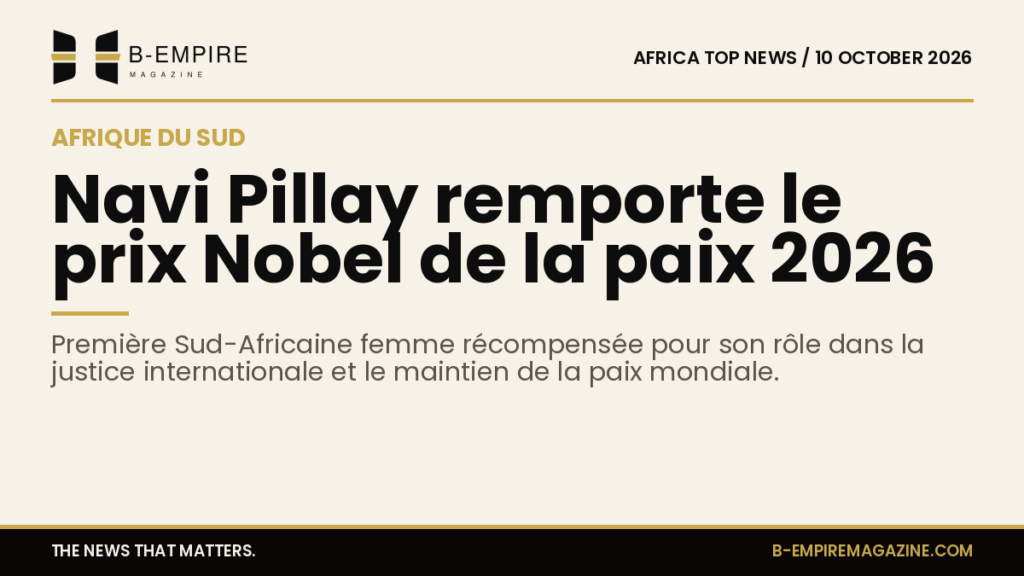
Navi Pillay Awarded 2026 Nobel Peace Prize, Affirming Global Legal Order
Navanethem “Navi” Pillay, a distinguished South African jurist and international judge, has been awarded the 2026 Nobel Peace Prize. Her recognition underscores the importance of international law amid global challenges. Pillay is the first South African woman to receive this prize and the fifth South African overall, following figures like Nelson Mandela and Desmond Tutu. She played a key role in establishing international justice institutions such as the International Criminal Tribunal for Rwanda and the International Criminal Court.
Brève Publié le (Africa/Lagos, UTC+1)
South African jurist Navanethem “Navi” Pillay has been awarded the 2026 Nobel Peace Prize, recognizing her exceptional contributions to international justice and human rights.
This award comes at a time when the international legal order faces significant pressure and challenges. Pillay’s recognition affirms the indispensable role of international law in maintaining global peace, despite its imperfections.
Pillay is the first South African woman to receive the Nobel Peace Prize and the fifth South African overall to be honored, joining prominent figures such as Chief Albert Luthuli, Archbishop Desmond Tutu, Nelson Mandela, and FW de Klerk. Her work is deeply rooted in the struggle against apartheid and white minority rule in South Africa.
Unlike Mandela, who became a global symbol of reconciliation, Pillay extended the lessons from South Africa’s struggle to the international stage. She was among the first judges at the International Criminal Tribunal for Rwanda, established after the 1994 genocide, and served on the International Criminal Court from 2003 to 2008. Her leadership helped to build the legitimacy and authority of these institutions tasked with holding perpetrators of grave human rights violations accountable.
Known for her humility, courage, and principled stance, Pillay has become a global symbol of accountability and justice. Her Nobel Prize not only honors her individual achievements but also serves as a vote of confidence in the global legal framework that seeks to uphold peace and human rights worldwide.