
Sudan’s BOOST Farming Project Moves From Approval to Delivery in Blue Nile and Sennar
Sudan's BOOST agriculture programme has begun implementation, targeting 232,000 smallholder farmers. Its harvest and storage goals are ambitious, but conflict and access will test delivery.
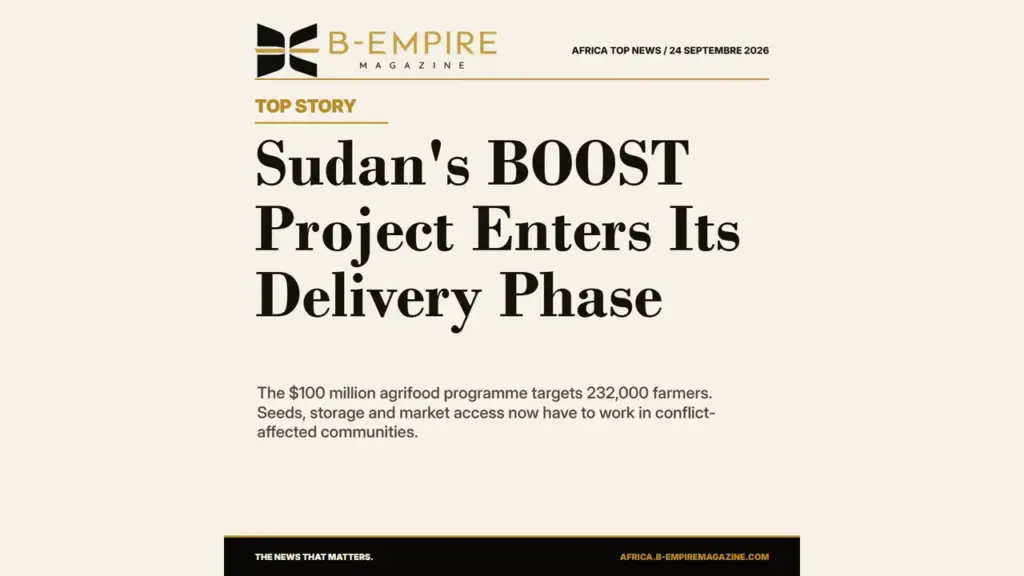
A Sudanese farming programme backed by the African Development Bank has entered implementation, shifting attention from a funding announcement to the work of getting seeds, storage and market support to farmers. The bank said on September 22 that the Boosting Agrifood Systems Resilience in Sudan project, known as BOOST, was formally launched at an event on September 15. Its immediate operating focus is 232,000 smallholder farmers in 175 cooperatives in Blue Nile and Sennar states.
The distinction between approval and delivery matters in a country where conflict, displacement and climate shocks have repeatedly disrupted rural production. BOOST received an $87 million grant approval from the African Development Fund in April. A project agreement with the World Food Programme, or WFP, was signed in May. The September event marks the implementation phase, not proof that the programme’s production and income targets have already been met.
What the programme is designed to do
BOOST is estimated to cost about $100 million. The African Development Fund contributes $87 million, while WFP, the UN Food and Agriculture Organization, UN Women and the International Maize and Wheat Improvement Center are associated with in-kind support valued at about $12.3 million, according to the bank’s approval notice. WFP is the implementing partner. The collaboration combines agricultural expertise, delivery capacity and a focus on women and young people who need routes into viable rural enterprises.
At the September launch, the bank described support for climate-resilient seed systems, improved technologies and sustainable production methods. Youth-led cooperatives and agricultural small businesses are intended to receive training, finance, technology, mentorship and help reaching markets. Those elements are related but not interchangeable. A farmer can raise yields and still lose value if a crop spoils before sale, a road is unsafe or a buyer cannot pay. An enterprise can receive training and still lack working capital for a growing season.
The project is expected to cover 1.16 million hectares and produce more than 980,000 tonnes of agricultural output worth an estimated $468 million, with an overall productivity increase of roughly 25%, the bank says. These are programme projections. They should be judged against actual harvested volumes, the area farmers can safely cultivate and prices they receive, rather than treated as output already delivered. Sudan’s conflict makes ordinary assumptions about access, staffing and transport unusually fragile.
Storage is a food-security intervention
BOOST’s storage component is unusually concrete. The bank says the project will distribute more than 1.2 million airtight storage bags to over 200,000 farmers and rehabilitate or equip 140 community-managed storage and processing facilities. It aims to cut post-harvest losses by 20% to 25%. If those measures work, farmers could keep more of what they grow and choose when and how to sell it. That would help food availability and household income without requiring every gain to come from new land or higher yields.
Delivery and maintenance will determine the result. Bags must reach farmers in usable condition and come with instruction suited to the crops being stored. Community facilities need fair access rules, reliable management, equipment repair and a way to cover running costs. If storage space is captured by a few better-connected users or cannot be operated after initial support ends, the projected loss reduction will remain on paper. Publishing facility locations and reporting actual use could help communities test whether the investment is serving them.
Storage is also only one link in a longer chain. Farmers need safe transport and buyers with purchasing power. Processing can add value locally, but equipment is useful only if power, spare parts and an operating model are available. These are implementation questions inferred from the project’s design, not deficiencies the bank says have already occurred. They are worth watching because production targets alone can hide weak market outcomes.
Women and youth must be able to participate
The African Development Bank says women and young people are central to the programme’s enterprise ambitions. Cooperatives and start-ups can give participants a shared channel for equipment, information and customers. Yet a programme that counts people trained without tracking who controls land, production decisions or revenue can overstate its impact. Meaningful inclusion would show up in access to inputs, finance and leadership positions as well as in income earned.
The bank’s April approval described a wider ambition to benefit more than 1.2 million people, including more than 232,000 farming households, and to create jobs directly and indirectly. The September launch uses the figure of 232,000 smallholder farmers. These figures describe different measures in the bank’s project communications and should not be added together. Neither is a final count of beneficiaries. Transparent monitoring should make clear how households, individual farmers, cooperative members and jobs are defined.
WFP’s role is particularly significant because BOOST is designed to help communities move beyond repeated emergency support toward local production and sales. Humanitarian assistance may still be indispensable where people cannot plant, harvest or access markets. The development programme does not replace that assistance overnight. Its value will depend on whether participants can rebuild a dependable livelihood under the conditions in which they actually live.
The conflict test for a four-year effort
The bank’s earlier project signing described BOOST as a four-year initiative. It also said the project would work with more than 230,000 farming households and that WFP would deliver it under third-party implementation arrangements. Those arrangements can provide operational reach, but insecurity still affects where teams can work, when inputs can be moved and whether farmers can remain on their land. Rainfall and seasonal timing add another constraint: late seed delivery can miss the window in which it is useful.
The bank says BOOST builds on its Sudan Emergency Wheat Production Project Phase II, which had reached 86,585 farmers and distributed more than 18,000 tonnes of certified seed and fertiliser by March 2026. That earlier experience provides a delivery reference, not a guarantee that BOOST will achieve its larger targets. The new programme’s results should be reported by location and season so setbacks, adaptations and successful approaches are visible.
Blue Nile and Sennar are the stated focus of the September launch, while the bank’s April approval also identified Kassala among key agricultural regions for the broader project. The difference is another reason to distinguish a launch-stage operating plan from the full design. Subsequent reporting should specify where support actually arrives and how many farmers participate in each state.
Sudan’s food crisis requires both urgent relief and a path to renewed production. BOOST now has financing, implementing partners and measurable goals for farms, storage and enterprise support. What comes next is less photogenic but more important: inputs delivered on time, facilities that function, harvests that can reach buyers and women and young people who retain a fair share of the value. Those outcomes, not the launch ceremony, will show whether the programme improves resilience.