
Aeon’s $1 Million Round Tests Nigeria’s Market for Homegrown Cybersecurity
Nigeria cybersecurity startup Aeon has raised $1 million in pre-seed funding. Its larger test is whether locally built security can win enterprise trust and protect critical African infrastructure.
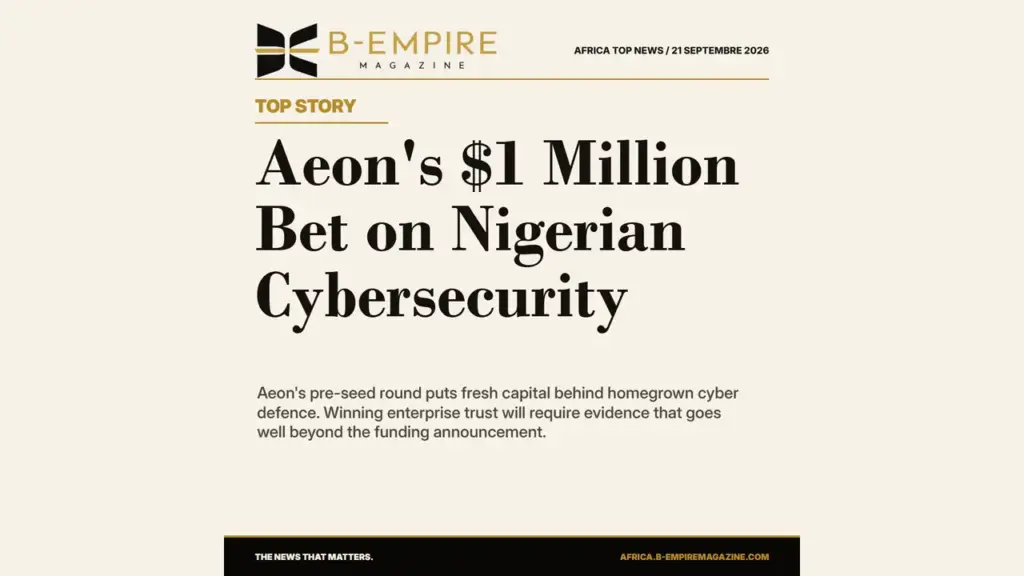
Nigerian cybersecurity startup Aeon has raised $1 million in a pre-seed round led by Terra Industries, putting fresh capital behind an attempt to build cyber defence infrastructure for African organisations operating in high-risk sectors. The round, announced on September 18, also included Resilience17, the early-stage investment firm founded by Flutterwave chief executive Olugbenga Agboola, as well as DFS Labs, Kaleo Ventures, Seedstars and Ajim Capital, according to reporting by Condia.
Aeon was founded by Samuel Ogbonyomi, Ben Eluan and Alex Idowu after work on cloud infrastructure products at PipeOps. The company says its product suite combines Aeon Edge, a device designed to secure networks and data at the perimeter, with Aeon Console, a platform intended to identify and remediate vulnerabilities across code, cloud systems and endpoints. Terra says the investment followed a pilot between the companies and is accompanied by a commercial joint venture targeting government and corporate customers.
The announcement is notable because African technology funding is still concentrated in familiar areas such as financial technology, commerce and logistics. Cybersecurity often appears as a cost centre rather than a venture-scale market, even as banks, energy operators, cloud providers and public institutions become more dependent on connected systems. Aeon’s round does not prove that a large local market already exists. It does create a useful test of whether African security companies can convert regional knowledge and strategic partnerships into trusted, repeatable products.
The threat environment is expanding faster than defence capacity
The commercial case is grounded in a worsening threat environment. INTERPOL’s 2026 African Cyberthreat Assessment, based on survey data from 36 member countries, found that artificial intelligence was enabling 55 percent of reported cybercrimes across the continent. It said cybercrime-related losses had more than doubled since 2024, rising from $192 million to $484 million, with AI-assisted scams, credential harvesting and automated social engineering among the main drivers.
West Africa faces particular exposure to business-email compromise and romance scams, while the report identified a lack of real-time data sharing among banks, telecommunications companies and law-enforcement agencies as a major blind spot. Nigeria’s national computer emergency response team issued its own high-risk advisory in April, warning organisations about a rise in phishing, ransomware, business-email compromise and data breaches. It urged operators of critical national information infrastructure to strengthen controls and remediate known vulnerabilities.
These are not abstract problems reserved for security departments. A successful attack can halt operations, expose customer information, divert payments, disrupt energy or communications systems and create regulatory liabilities. As more African businesses move workloads to the cloud and connect physical equipment to software, the boundary between operational security and information security becomes harder to maintain. Terra’s interest in combining physical protection with digital defence reflects that convergence.
Sovereign cybersecurity needs a practical definition
Aeon and Terra describe the ambition as sovereign cyber defence for Africa and the wider Global South. The phrase is strategically appealing, but buyers will need a more precise proposition. Sovereignty should not mean that every component must be developed within one country or that organisations should isolate themselves from global threat intelligence. Cyberattacks cross borders, and effective defence depends on international standards, shared indicators and specialised technology.
A credible local-security proposition can instead rest on four practical advantages. The first is knowledge of regional infrastructure, payment systems, regulatory obligations and common attack patterns. The second is control over how sensitive telemetry and customer data are stored, processed and shared. The third is the ability to support clients locally during an incident rather than relying exclusively on teams several time zones away. The fourth is product design that fits the budgets, connectivity constraints and technical capacity of African organisations.
Those advantages are possible, not automatic. A product built in Nigeria can still mishandle data or miss an attack, just as a global vendor can. Customers in banking, energy, government and cloud infrastructure will judge Aeon on security architecture, access controls, encryption, auditability and incident response. Local origin may open a conversation, but independent evidence must close the sale.
The Terra partnership offers distribution and concentration risk
Terra is more than the lead investor. The companies say they have formed a joint venture to pursue military and commercial deployments, with Terra protecting physical assets and Aeon handling digital systems. That relationship could give a young software company access to complex customers and operating environments that would normally take years to reach. A successful pilot also provides a stronger starting point than a partnership built only for a press release.
Yet the same closeness creates questions that sophisticated buyers and future investors will ask. Aeon needs to demonstrate demand beyond a single strategic partner’s network. Revenue concentrated through Terra could accelerate early growth while leaving the company dependent on one route to market. Shared investors and joint bids also make clear governance, pricing and responsibility essential, particularly when contracts involve public institutions or sensitive infrastructure.
Customers need to know which company is accountable when a system fails, how security data moves between the partners and who can access it. Procurement teams will also want assurance that Aeon’s product can integrate with equipment and software supplied by companies other than Terra. An open, well-documented integration model would make the platform more useful and reduce fears of vendor lock-in.
Enterprise trust is built through verification
Cybersecurity startups face an unusual credibility challenge: they must persuade customers to entrust them with the systems attackers most want to reach. Marketing claims about an all-in-one view or AI-powered defence are not enough. Aeon will need third-party penetration tests, secure-development practices, clear vulnerability-disclosure procedures and relevant certifications. Buyers may also require data-residency options, detailed service-level agreements and evidence that the company can respond when a breach occurs outside ordinary business hours.
Product breadth can be an advantage if it reduces fragmented tooling. It can also become a weakness if a small team attempts to cover networks, code, cloud infrastructure, endpoints, compliance and threat intelligence before mastering any one layer. The funding round is modest relative to the research, engineering and support costs of enterprise security. Aeon’s management will therefore need to choose where it can produce a measurable advantage and where established third-party tools should remain part of the stack.
Artificial intelligence deserves particular caution. INTERPOL’s findings show how quickly attackers are adopting AI, but adding AI to a defence product does not guarantee better outcomes. Automated systems can overwhelm teams with false alerts, conceal uncertain reasoning or take disruptive actions. Customers should ask how models are trained, what data they use, how decisions are reviewed and whether critical remediation requires human approval. Performance should be tested against realistic attacks, not only demonstrations.
What the $1 million should prove
The most important near-term measure is the conversion of pilots into paid deployments. A pilot may validate technical interest while saying little about willingness to pay, procurement cycles or renewal. Aeon should be able to show that customers use the platform in production, expand their contracts and continue after the initial deployment. Revenue quality matters more than the number of logos displayed on a website.
Operational metrics should be equally concrete. Useful measures include time required to detect and contain an incident, the proportion of critical vulnerabilities remediated within an agreed period, false-positive rates, service availability and response times. For a platform promising a unified view, Aeon should also demonstrate that it can ingest information from different environments without creating another isolated dashboard.
Talent will be another constraint. Cyber defence requires experienced engineers, threat researchers, incident responders and compliance specialists, all of whom are in global demand. The round can help Aeon recruit and retain a core team, but sustainable capability also requires training pipelines and documented processes that do not depend on a few founders. Partnerships with universities, professional associations and national response institutions could expand that base without turning the company into a substitute for public cyber capacity.
Finally, governance should develop alongside the technology. Handling security telemetry from critical organisations creates responsibilities that can extend beyond ordinary software services. Aeon needs transparent rules for retention, cross-border transfers, lawful requests and deletion. Where government or military work is involved, safeguards around civilian customer data and internal access become even more important.
A local market can grow without becoming insular
African cybersecurity companies have an opportunity to build products around threats and infrastructure that global vendors may not prioritise. That opportunity should complement, rather than reject, international cooperation. INTERPOL’s 2026 recommendations emphasise standardised digital forensics, cross-border coordination, AI literacy and formal public-private partnerships. Local vendors can contribute threat intelligence and faster response while still using open standards and working with global researchers.
For Nigeria, the deeper value of Aeon’s round would be proof that cybersecurity can become an exportable technology capability rather than only an imported expense. A successful company could create specialised jobs, retain more security spending within the region and give institutions additional choices. It could also encourage investors to evaluate cyber defence as infrastructure, where long procurement cycles and demanding customers can produce durable relationships once trust is established.
The $1 million pre-seed round is therefore a beginning, not validation of the full vision. Aeon has strategic backing, an urgent market problem and a partnership that could accelerate access to customers. Its next stage will be judged less by the language of sovereignty than by independently tested products, paid deployments, transparent governance and measurable reductions in risk. If it delivers those outcomes, the funding could mark an important step toward a stronger African security industry. If it does not, the announcement will remain another reminder that in cybersecurity, trust cannot be financed into existence; it has to be earned in operation.