
Chad’s Mining Permit Freeze Tests Africa’s Resource-Control Turn
Chad's decision to freeze new mining prospecting authorisations is a regulatory pause with bigger implications for gold, diversification and resource sovereignty.
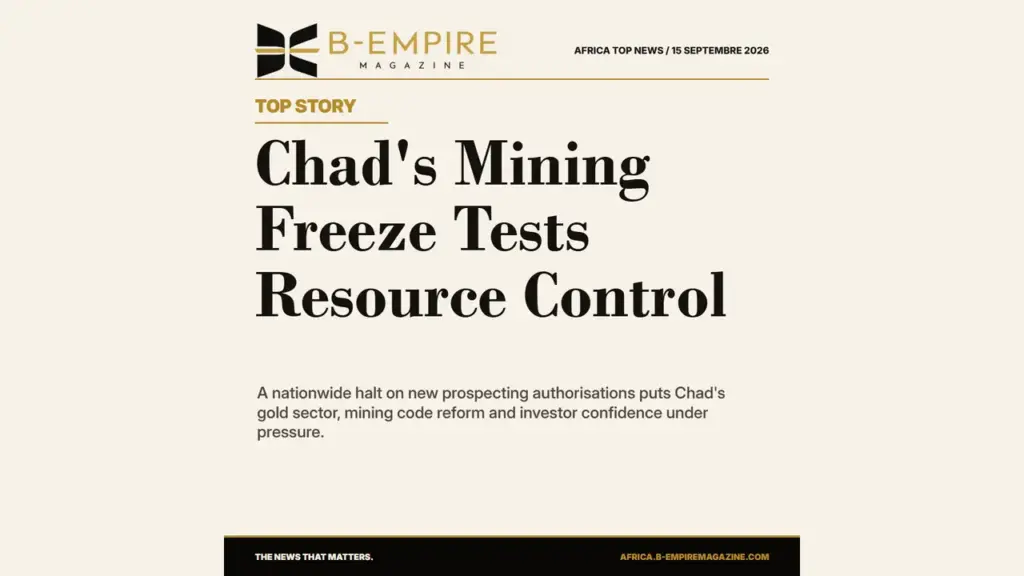
Chad has suspended all new mining prospecting authorisations across its national territory until further notice, placing the country’s gold sector and wider resource-governance agenda under fresh scrutiny. The measure follows ministerial decree n°064 signed on 10 September 2026 by Mines, Petroleum and Geology Minister Fatima Haram Acyl, and was formalised through a circular dated 11 September to mining companies, economic operators and institutional partners.
The suspension applies to new applications for mining prospecting authorisations. It does not automatically cancel existing titles, but it closes the administrative window for new entrants and delays the next phase of exploration activity. The Directorate General of Geology and the Mining Cadastre notified stakeholders that all new applications are frozen from 11 September until further notice. No end date has been announced.
The decision is more than a bureaucratic pause. It comes as Chad is trying to strengthen control over a gold sector that has become increasingly important to its diversification strategy. According to reporting by Capmad and APA News, Chad had 324 identified gold-mining sites in 2024, while authorities have previously announced plans for four gold-processing plants. By freezing new prospecting, the government is signalling that access to mineral acreage is now a sovereignty issue as much as an investment issue.
Why the freeze matters
Mining prospecting authorisations are the entry point to future mineral projects. They allow companies and operators to identify deposits, gather geological data and prepare more advanced research or exploitation applications. When a government freezes the intake of new prospecting requests, it does not merely slow paperwork. It temporarily changes the pipeline of future projects.
For investors, the immediate effect is uncertainty. Companies considering Chad must wait to see how long the suspension lasts, whether pending applications are affected and what new rules may follow. For the government, the freeze creates time to review the cadastre, assess overlaps, tighten controls and align new permits with a reformed mining framework. The tension between those two priorities will shape market reaction.
Chad is not alone. Across Africa, governments are reviewing mining codes, renegotiating contracts, tightening local-content rules and asserting more control over critical minerals, gold and strategic resources. Mali, Senegal, Zimbabwe, the Democratic Republic of Congo, Tanzania and Ghana have all taken steps in recent years to capture more value or improve oversight. Chad’s move fits this continental pattern, but its impact will depend on execution.
Gold, informality and state control
Gold sits at the centre of the story. Chad’s gold sector includes artisanal, semi-mechanised and formal activity spread across areas where state oversight, security and environmental monitoring can be difficult. Gold can provide income and export potential, but it can also fuel smuggling, local conflict, land disputes and revenue leakage if not managed properly.
The government’s stated logic is control and organisation. Capmad reported that authorities view the suspension as a way to regain command over the mapping of mining titles and strengthen the organisation of a sector that has become central to economic diversification. That explanation is credible. A poorly mapped permit system creates room for overlapping claims, speculative licence trading and conflicts between artisanal miners, local communities and industrial operators.
At the same time, a freeze is only useful if it leads to clearer rules. If the suspension becomes open-ended without transparent criteria, investors may read it as policy unpredictability. If it is used to clean up the cadastre, clarify title categories and strengthen environmental and revenue controls, it could improve confidence over the medium term. The difference lies in whether the government publishes a process, timeline and reform logic.
The mining code backdrop
The timing suggests a connection to legal reform. On 8 September, the Ministry of Mines, Petroleum and Geology launched a national workshop in N’Djamena to validate a draft mining code and implementing texts. The permit freeze followed almost immediately. The ordinary Council of Ministers had also examined and adopted a draft Petroleum Code on 3 September, indicating a broader review of Chad’s extractive-sector rules.
A mining code defines the rights and obligations of companies, the state and communities. It sets rules on permits, fiscal terms, environmental management, local content, land access, renewal procedures, reporting and dispute resolution. If Chad is revising that framework, temporarily halting new authorisations may be intended to avoid granting titles under rules that are about to change.
That approach can be defensible, but it should be communicated clearly. Companies can tolerate a reform pause if they understand what is being fixed and when the system will reopen. They struggle when suspensions are vague. The best-case scenario is a short, disciplined pause followed by a modernised code and a cleaner cadastre. The worst-case scenario is a long freeze that discourages legitimate investors while informal activity continues outside the formal permit system.
Investor confidence versus sovereignty
African governments often face a difficult balance. Investors want stable rules, predictable timelines and security of title. Governments want more revenue, stronger oversight and control over resources that have too often generated limited domestic value. Both concerns are legitimate. The challenge is to design systems that make mining investable without turning mineral rights into a giveaway.
Chad’s freeze may appeal to citizens who believe the state should control its gold sector more firmly. It may also unsettle companies that fear sudden regulatory decisions. The government’s task is to show that this is not arbitrary intervention, but part of a credible reform programme. That means publishing the scope of the suspension, clarifying how existing permits are treated, explaining the link to the mining code process and committing to transparent reopening conditions.
Resource sovereignty is strongest when it is rules-based. A state that can map its titles, enforce contracts, monitor production, protect communities and collect taxes has more power than a state that simply suspends activity. Chad’s move will therefore be judged by what comes next, not only by the decree itself.
Communities and environmental pressure
Mining reform cannot be only about investors and government revenue. Communities near mining sites often bear the costs of land disruption, water stress, pollution, insecurity and social tension. Artisanal gold sites can generate livelihoods, but they can also expose workers to dangerous conditions and environmental harm. Industrial projects can bring jobs and infrastructure, but they can also trigger displacement and conflict if consultation is weak.
A stronger mining framework should address those issues directly. Environmental impact assessment, community compensation, local employment, revenue-sharing, mercury control, site rehabilitation and grievance mechanisms should be part of the reform agenda. If the permit freeze gives the state time to improve these safeguards, it can serve public interest. If it only reshuffles access to mining titles, the social problems will persist.
Chad’s gold sector also operates in a wider security environment. In parts of the Sahel and Central Africa, gold has become linked to informal financing networks, armed actors and smuggling routes. Formalising and monitoring the sector is therefore also a security issue. But heavy-handed control without livelihood alternatives can create new tensions. Reform needs enforcement, but it also needs economic realism.
What to watch next
The first indicator is the duration of the freeze. A short pause tied to a clear reform process will be read differently from an indefinite suspension. Investors, communities and operators need a calendar or at least a set of conditions for reopening.
The second indicator is the draft mining code. If the new framework improves transparency, cadastre management, environmental controls and local value creation, the suspension may be seen as part of a serious reset. If the code remains opaque, uncertainty will grow.
The third indicator is treatment of pending and existing applications. Companies will want to know whether already submitted files are frozen, returned or reviewed under new rules. Existing title holders will also watch for signs that the suspension could widen into a broader review.
The fourth indicator is enforcement. If formal applications are frozen but informal extraction continues unchecked, the policy will hurt compliant operators more than the behaviours it claims to control. The credibility of the measure depends on even implementation.
The bottom line
Chad’s mining permit freeze is a small administrative sentence with large consequences. It pauses the flow of new prospecting authorisations at a moment when gold is becoming more central to the country’s diversification strategy and when the mining code is being reviewed. The measure could become a useful reset if it produces clearer rules, a cleaner cadastre and stronger oversight.
It could also become a warning sign if it stretches indefinitely or is applied without transparency. Investors need predictability. Citizens need accountability. Communities need protection. The state needs sovereignty that is more than a slogan.
The next few months will show which direction Chad chooses. A well-managed pause could strengthen the country’s bargaining position and make future mining investment more credible. A poorly managed freeze could slow exploration, push activity into informality and weaken confidence. In Africa’s wider resource-control turn, Chad has now joined the list of states trying to rewrite the mining bargain. The hard part is making the new bargain work.
Sources
- Capmad – Chad freezes all new mining exploration permits under ministerial decree n°064, 14 September 2026
- APA News – Chad suspends new mining prospecting authorisations, 12 September 2026
- Le N’Djam Post – New prospecting applications suspended, 12 September 2026
- Tchadinfos – Mines: Chad suspends all new prospecting authorisations, 12 September 2026
- Ecomatin – Chad suspends all new mining prospecting requests, 14 September 2026